Type · miletos-lion-star-obol
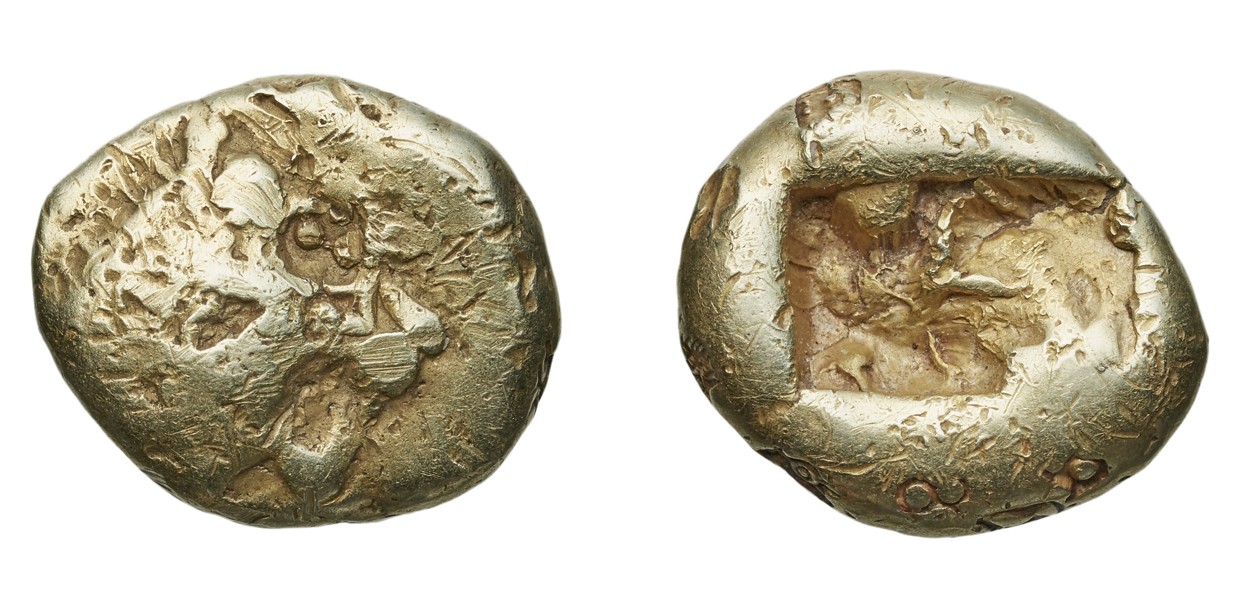
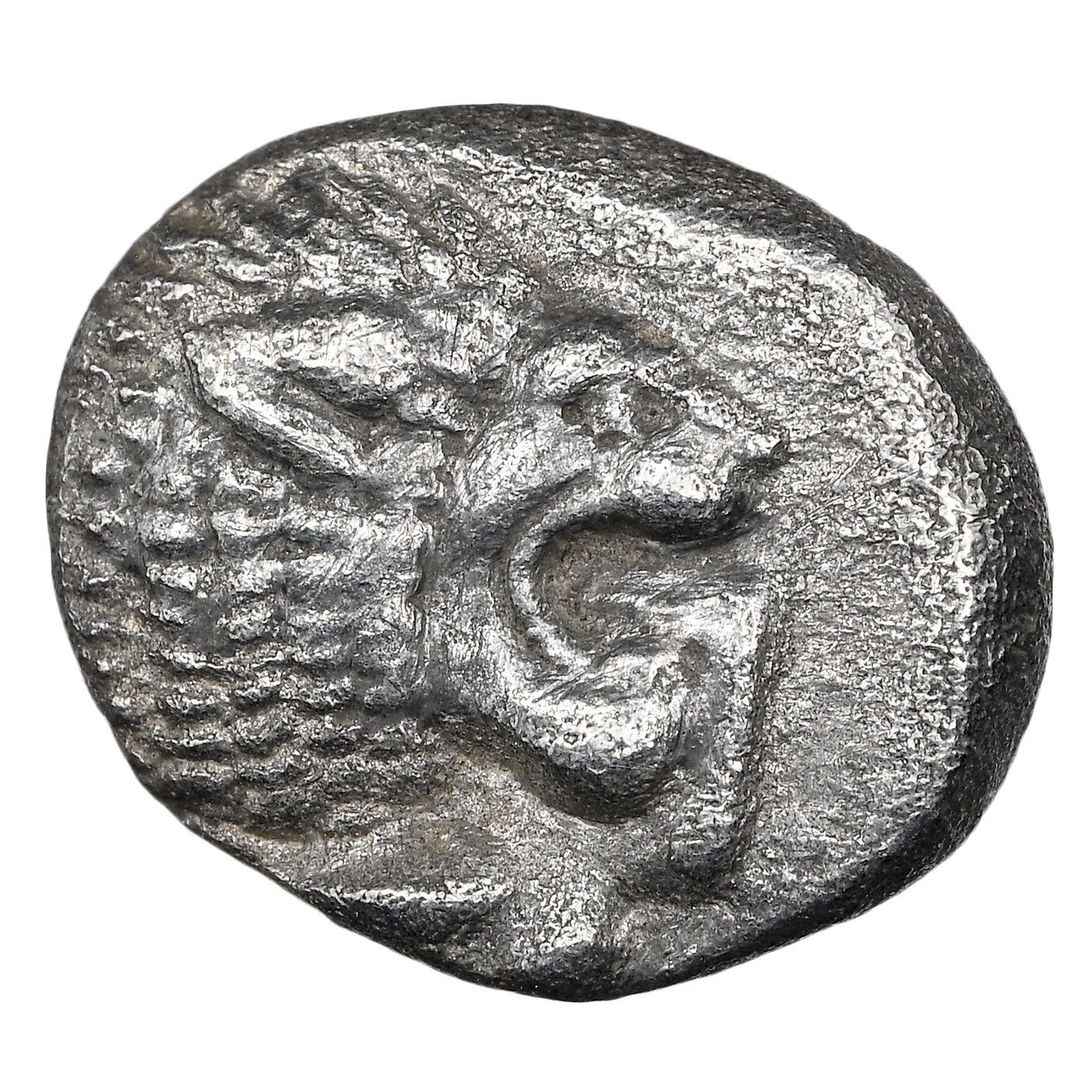
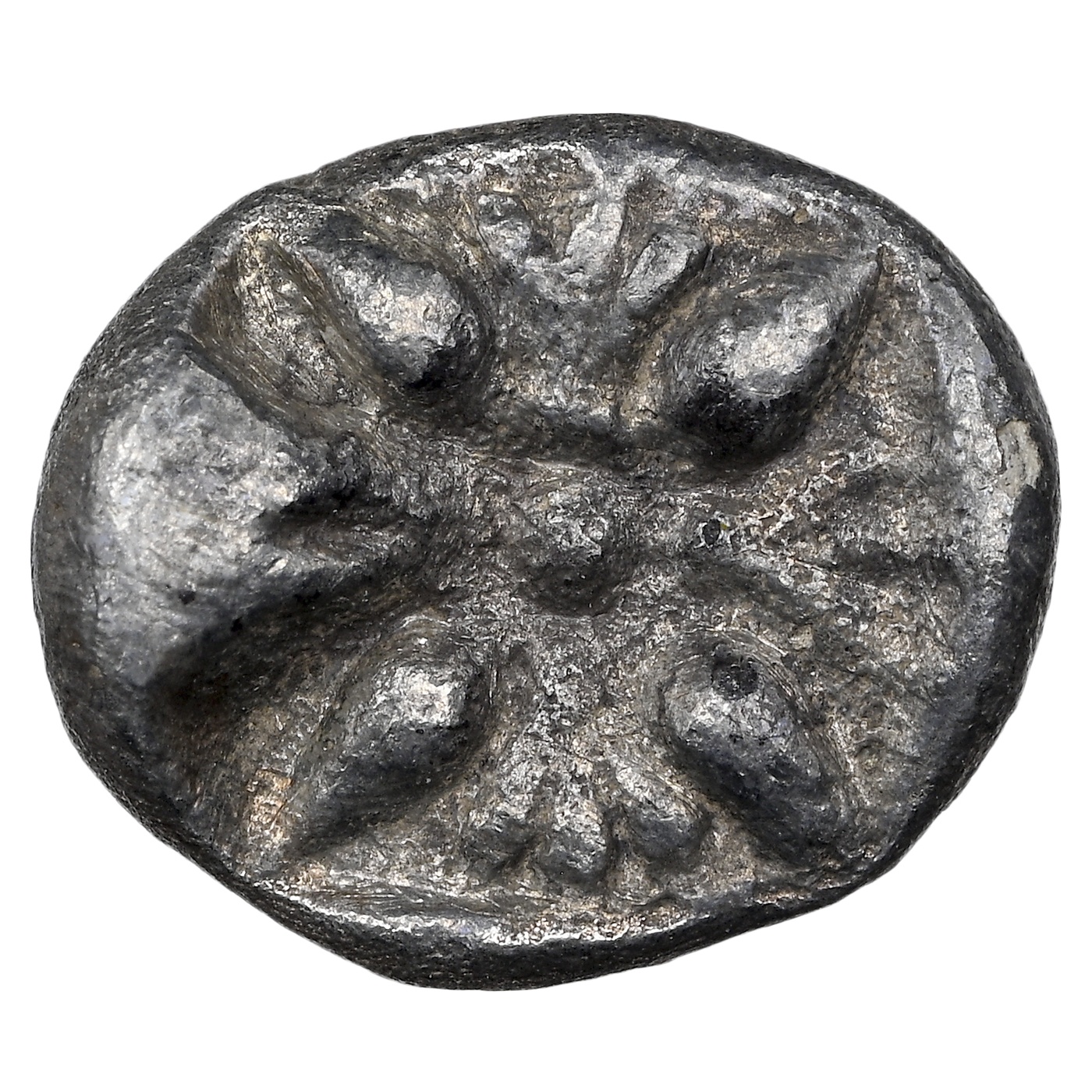
Current: Ionia, Miletos, AR 1/12 stater (obol), c. 525–494 BC (the house: late 6th–5th centuries BC). Forepart of roaring lion left, head reverted / stellate floral pattern with a central diamond enclosing a pellet, all within an incuse square. Milesian (Lydo-Milesian) standard. SNG Kayhan 462–475; SNG von Aulock 2082; SNG Copenhagen 952.
Obverse: Forepart of a roaring lion to the left, the head turned back over the shoulder (reverted), mane rendered as rows of short strokes
Reverse: Stellate floral pattern — four large petal-shaped rays on the diagonals with smaller rays between them, around a central diamond enclosing a pellet — all within an incuse square
Primary reference: SNG Kayhan 462–475
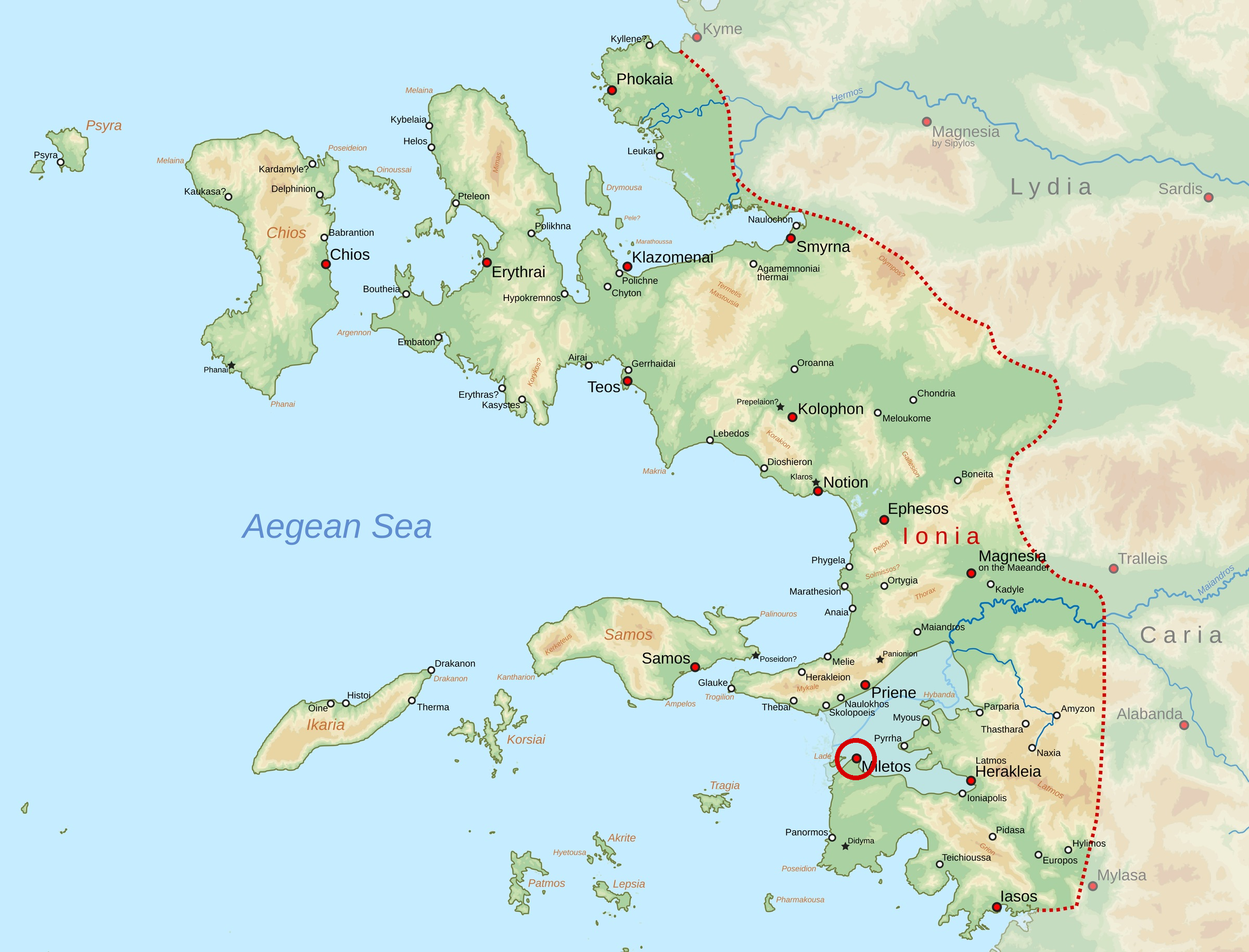
Ancient Ionia, on the Aegean coast of Asia Minor. Miletos is circled in red, at the southern end of the Ionian coast on the gulf into which the Maiandros (Maeander) then flowed — the sea the river has since silted into a plain. The little island of Lade, where the Ionian fleet was beaten in 494 BC, lies just off the city; the oracle of Apollo at Didyma, sacked in the same year, is the star to the south. The collection’s other Ionian coins were struck up the coast: the griffin stater of Teos a generation earlier, and the Alexander tetradrachm of Kolophon two centuries later.
“Map of ancient Ionia” by Tomisti (Wikimedia Commons), File:Ancient Ionia map en.svg, licensed CC BY-SA 4.0; cities and roads based on the Digital Atlas of the Roman Empire (DARE) and Pleiades; topographic base © OpenMapTiles, © OpenStreetMap contributors (https://commons.wikimedia.org/wiki/File:Ancient_Ionia_map_en.svg; license: https://creativecommons.org/licenses/by-sa/4.0/). Modified by JSB Coins: rasterized from SVG to a 2400 px PNG, and a red circle added to mark Miletos; the inset is a crop of the same rasterization. Drawn on the unringed base kept at maps/Ancient_Ionia_map_en_2400.jpg — the collection’s other copies are ringed at Teos and at Kolophon. This derivative is shared under the same CC BY-SA 4.0 license.
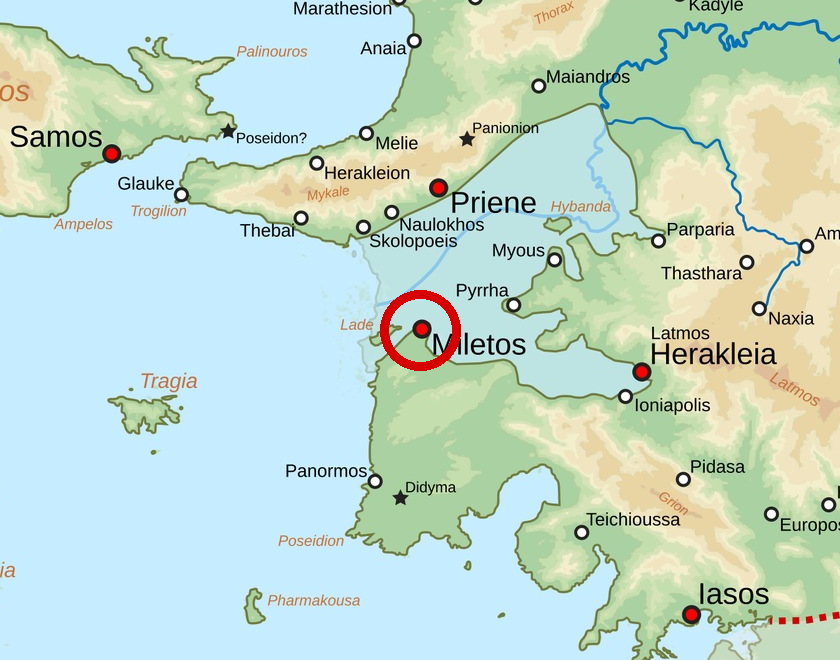
Detail: Miletos on its peninsula at the mouth of the Maiandros, with Lade offshore, Myous and Priene across the gulf, and Didyma to the south.
Ten millimetres across, this is the smallest coin in my cabinet, and it comes from the greatest city of archaic Greece. Miletos, at the southern end of the Ionian coast, was the city of Thales and Anaximander, the mother of colonies from the Black Sea to Egypt, and — in Herodotus’ phrase for the years just before it all went wrong — “the ornament of Ionia” (Hdt. 5.28). Its badge was a lion, and its lion has a habit no other Greek city’s lion shares: it turns its head to look back over its shoulder. On this little silver twelfth the forepart of the beast crouches to the left, jaws open, mane in neat rows, and the head is wrenched round to the right to stare at whatever is behind it. The reverse is the sunk square of the punch, and in it a starburst: four big petal-shaped rays on the diagonals, smaller rays between, and at the centre a diamond with a pellet in it.
It was struck in the last generation before the Persians destroyed the city in 494 BC, and it is the small change of that generation — the coin of the market, not the treasury. There are thousands of them. Each one is a scrap of the money that paid for the Ionian Revolt, and the type stops dead when the city does.
Graphic: JSB Coins, 2026 (CC0).
Miletos sits at the mouth of the Maiandros, on a peninsula that was then washed by the sea on three sides and is now a hill in a plain, because the river has spent twenty-five centuries filling in the gulf. In the seventh and sixth centuries it was the most enterprising place in the Greek world: ancient tradition credited it with dozens of colonies, above all along the Black Sea and its approaches. Two of them are in this collection: Panticapaeum, on the Kerch strait, whose Pan-headed bronze paid for the grain that fed Athens, and Kyzikos, on the Sea of Marmara, whose tunny-fish electrum and tiny silver fractions are also in this collection. Milesian merchants had their own precinct at Naukratis in the Nile delta. And the city produced the men who invented natural philosophy: Thales, who is said to have predicted an eclipse and who advised the Ionians to set up a single council at Teos, the central city of the coast (Hdt. 1.170); Anaximander, who drew the first map; Hekataios, who wrote the first geography and told Aristagoras not to revolt.
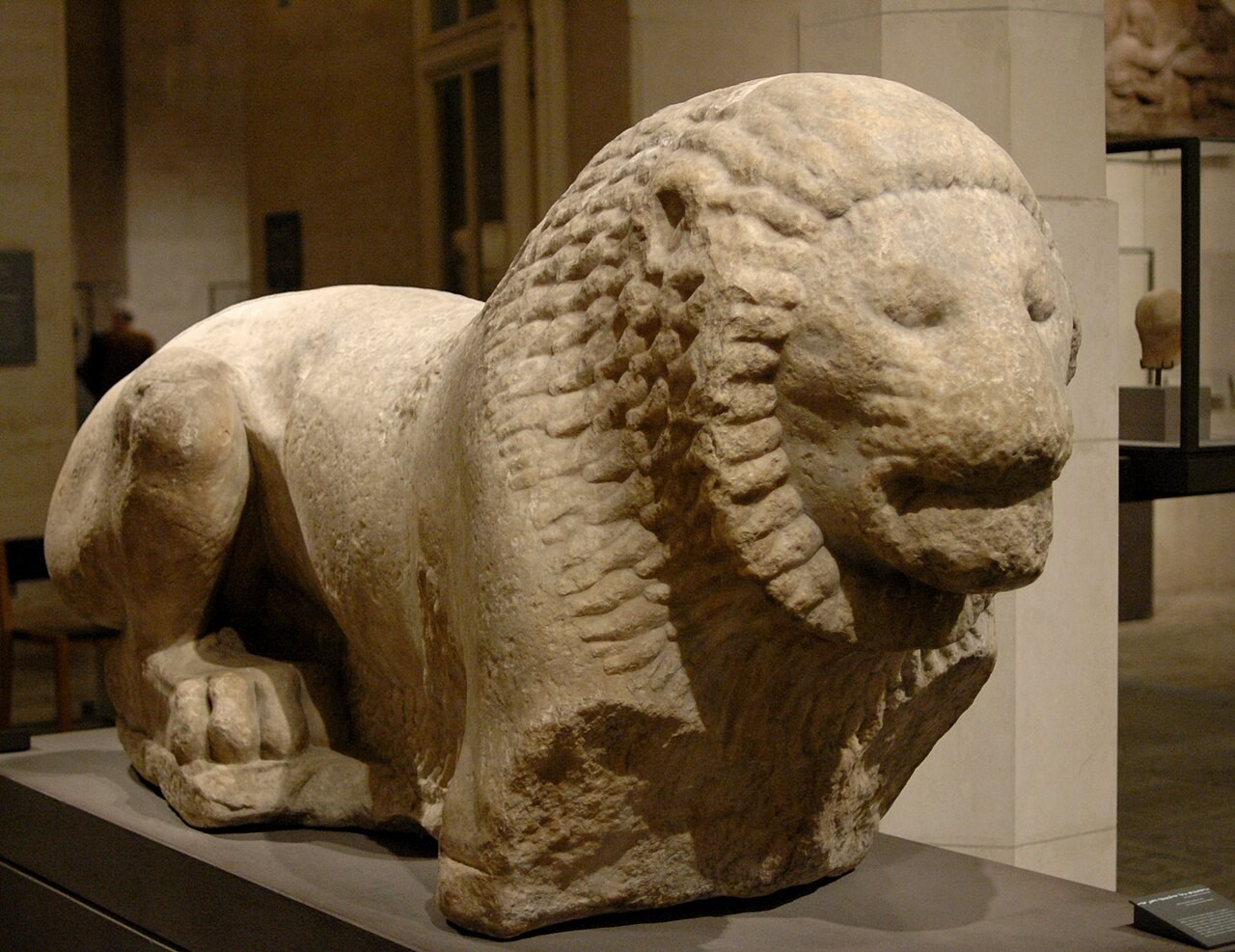
Photo: Marie-Lan Nguyen (Jastrow), 2006, public domain (Wikimedia Commons); reproduced unmodified.
Its neighbour and rival was Lydia. Herodotus opens his history of the Lydian kings with Alyattes’ eleven-year war against Miletos, which the Lydians fought by burning the crops each harvest and leaving the houses standing so that the Milesians would have something to sow again — until a Lydian fire spread to the temple of Athena at Assesos, the king fell ill, and the oracle told him to rebuild it. The tyrant Thrasybulos then outwitted the Lydian envoy by piling the market with food and staging a festival, Alyattes concluded the city was unbreakable, and the two made peace as “guest-friends and allies” (Hdt. 1.17–22). That treaty is the thread of Milesian history for the next century. When Croesus subdued the rest of Ionia the Milesians kept their alliance, and when Cyrus took Sardis in 546 BC and the Ionians came begging for the terms they had refused him before, he answered them with the fable of the flute-player and the fish — except the Milesians, who had made their own agreement with him and alone of the Ionians “were out of danger” (Hdt. 1.141, 1.143). The lion’s treaty with the Lydian lion had been handed on to Persia.
The head-turned lion is very old at Miletos. The city’s electrum — the pale-gold coinage that the Lydians and the Ionians struck before anyone struck silver — carries a recumbent lion with its head reverted, and Hilbert’s die study of more than a thousand of those coins (Die Elektronprägung von Milet, 2018) links the lion-with-reverted-head series to the earliest Milesian issues by shared reverse dies, which pushes the beginning of the city’s coinage back to 610 BC or earlier (Ellis-Evans, Wartenberg and Kagan 2022). So the badge on this silver twelfth had been the city’s for a century when it was cut, and the crouching pose on the electrum is what the silver reduces to a forepart.
What the reverse shows is less certain than what the obverse shows. The house calls it a “stellate floral pattern”; the catalogues variously say star, sun and flower, and the site that has studied this coinage most closely files the series under “lion-sun”. The Lydian trite in this collection carries a four-rayed sun, or radiate boss, on the lion’s forehead, and it is tempting to read the two together — a lion and a sun as a shared eastern-Greek pairing — but nobody has shown that the Milesian starburst means the same thing, and I leave it as a star, a sun or a flower, with the diamond and pellet at its heart unexplained.
The weight standard is Lydia’s. Kroll’s account of the Lydian coinage sets out the Lydo-Milesian stater of about 14.1 g and its division into thirds, sixths, twelfths and smaller fractions, and the Milesian silver keeps the same scheme: a stater of 14.1 g, a twelfth of about 1.18 g. That is what this coin is — the twelfth of a stater, an obol-sized piece, which is why the house calls it “1/12 stater or obol” and why both names appear on this page. The collection’s Croeseid third-stater and siglos are the same standard in the Lydian king’s own silver; the Achaemenid siglos is what the Persians made of it afterwards. No weight is recorded for my coin: it is sealed in an NGC holder of the older kind that carries no weight, and the house gave none, so the standard figure is the only number there is.
Coins this small were struck in enormous numbers and are still common; the Milesian twelfths survive by the thousand, which is the best evidence there is for how many were made and for how the city used them. A stater or a tetradrachm paid a ship’s crew or a mercenary; a twelfth bought bread. They travelled, too: one turned up in the survey of Kelainai, the Persian governor’s seat far inland in Phrygia, dated about 500 BC (Zakharov, in the Oxford survey above) — a Milesian obol two hundred kilometres from the sea, in the years of the revolt.
The usual dating of the series is the last quarter of the sixth century down to 494 BC, and a case has been made that the bulk of it belongs to the revolt years, when the city was paying for a war. I record that as a suggestion rather than a fact: the coins carry no date, and the argument is from volume and from the abrupt end of the type. What is not in doubt is that the type stops with the city.
The Ionian Revolt began at Miletos, and Herodotus tells it as a story about one man’s debts. Aristagoras, ruling the city as deputy for his father-in-law Histiaios (whom Darius was keeping at court), promised the Persian satrap a cheap conquest of Naxos, failed, and found himself owing the cost of a fleet he could not pay for. A message tattooed on a slave’s scalp arrived from Histiaios telling him to revolt, and he did: he “pretended to resign the despotic power and give to Miletos equality” (Hdt. 5.37), deposed the tyrants of the other Ionian cities, and went west for help. Sparta turned him down when Cleomenes learned from his bronze map that Susa was three months’ march from the sea (Hdt. 5.49–51); Athens sent twenty ships (5.97). With them the Ionians marched up the Kaystros valley and burned Sardis (5.99–102), the city whose kings had once besieged theirs — and Darius, told who the Athenians were, is said to have had a servant repeat three times at every dinner, “Master, remember the Athenians” (5.105). The owls of Athens in this collection are, in a sense, the other end of that sentence.
The war lasted six years and ended at sea. In 494 the Ionian fleet of 353 ships gathered at the island of Lade in front of Miletos, the Milesians themselves furnishing eighty (Hdt. 6.7–8); the Samians and Lesbians deserted as the battle began, and the Persians won. Then they took Miletos by siege and mine, “in the sixth year from the revolt of Aristagoras, and reduced the people to slavery” (6.18). The men were killed or deported, the women and children enslaved, and the survivors were settled by Darius at Ampe on the Tigris, near the Persian Gulf (6.20). The oracle of Apollo at Didyma, a few miles south of the city, was plundered and burnt (6.19). When the tragedian Phrynichos staged The Capture of Miletos in Athens the audience wept, the city fined him a thousand drachmas for reminding them of their own misfortunes, and the play was banned (6.21).
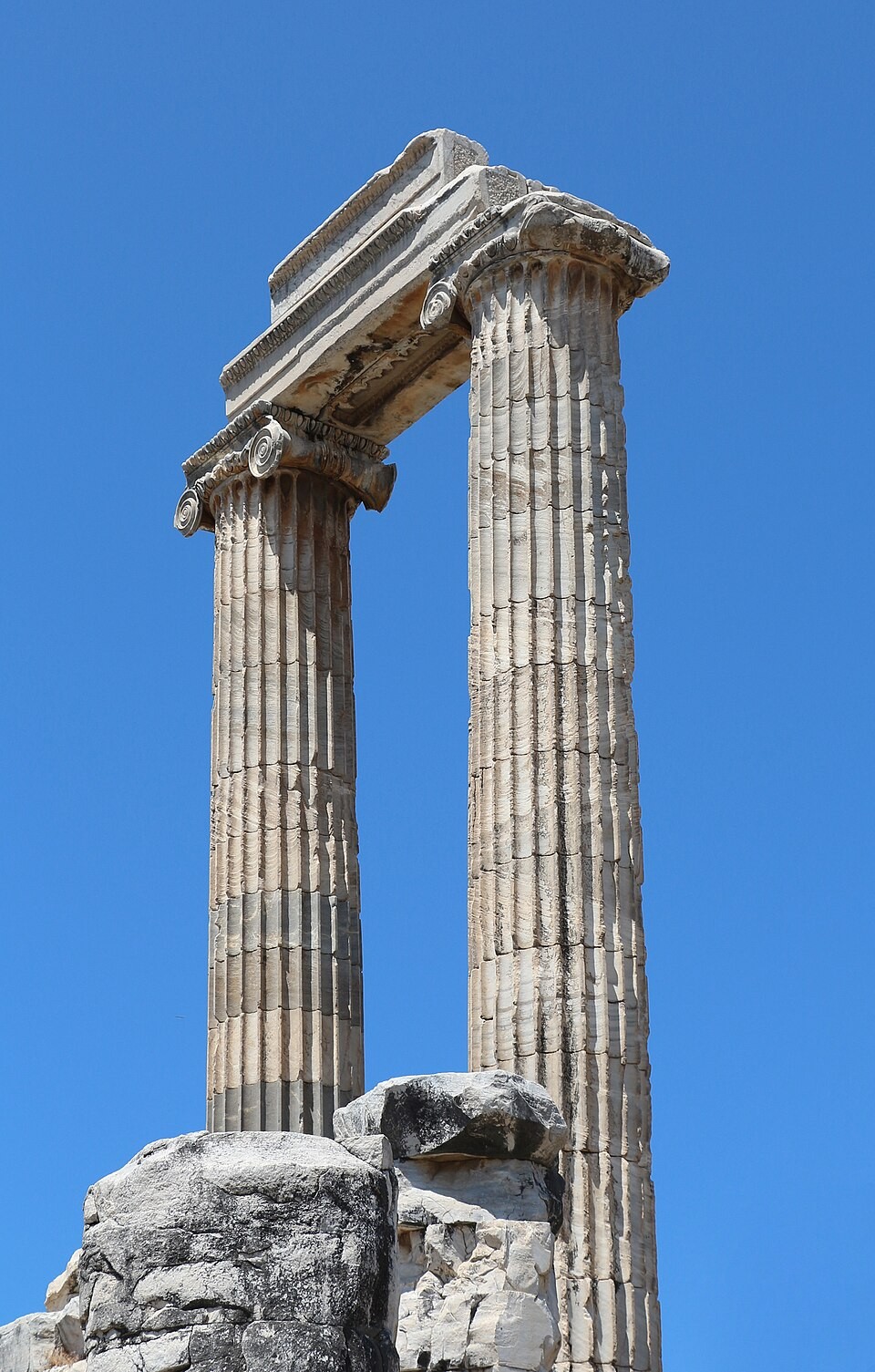
Photo: Bernard Gagnon, Wikimedia Commons, licensed CC BY-SA 3.0; reproduced unmodified.
This coin was in someone’s purse during those years. The lion looking back over its shoulder is an old device and not a comment on events, but it is hard, holding the coin, not to read it as one.
Miletos was refounded after the Persian defeat of 479 BC and rebuilt on the regular grid that Greek city-planning is named for; it joined the Athenian league, revolted from it, was fought over by Persia, Athens and Sparta, and was besieged and taken by Alexander in 334 BC. Its mint outlived all of this. Under the Persian peace the lion came back on new silver; in Alexander’s day Miletos was, with Sardes, one of the two great mints of his drachms (Thompson, Alexander’s Drachm Mints I — the framework the collection’s Alexander drachm page rests on); and the lion with its head turned back went on appearing on Milesian coins into the Roman period. The archaic twelfth is the first chapter of that long run, and the last coin of the city that Herodotus called the ornament of Ionia.
Ancient: Herodotus 1.17–22 (Alyattes and Thrasybulos), 1.141 and 1.143 (Cyrus and the Milesian treaty), 1.170 (Thales), 5.28–38 (Aristagoras), 5.49–51, 5.97, 5.99–105 (Sardis), 6.7–21 (Lade, the fall of Miletos, Didyma, Phrynichos), in Macaulay’s translation on Wikisource, linked above. Numismatic: SNG Kayhan 462–475 and SNG von Aulock 2082 (the house’s references); SNG Copenhagen 952; J. H. Kroll, “The Coins of Sardis” (Sardis Expedition) for the Lydo-Milesian standard; A. Ellis-Evans, U. Wartenberg and J. Kagan, “Asia Minor: Archaic to Hellenistic (2014–2020)”, Survey of Numismatic Research 2014–2020, for Hilbert’s electrum die study (R. Hilbert, Die Elektronprägung von Milet, Nomismata 9, 2018), Weisser’s Aphrodite sanctuary find and Zakharov’s Kelainai fraction; M. Thompson, Alexander’s Drachm Mints I: Sardes and Miletus (ANS Numismatic Studies 16, 1983) for the later mint; R. J. O’Hara, Ancient Coins of Miletos (rjohara.net) for the twelfth-staters, their standard weight and the Ionian Revolt suggestion — site unreachable when checked; C. M. Kraay, Archaic and Classical Greek Coins (1976) and K. Konuk, “Asia Minor to the Ionian Revolt”, in The Oxford Handbook of Greek and Roman Coinage (2012), for the general framework, cited by name only.
DATING. The house and NGC give 'late 6th–5th centuries BC'; the usual placing of this series is before the destruction of Miletos in 494 BC, roughly the last quarter of the sixth century and the years of the Ionian Revolt (O'Hara; SNG Copenhagen dates its example 'late 6th century'). The card uses c. 525–494 BC and keeps the house's wider bracket in date_text. THE STANDARD. Milesian, i.e. the Lydo-Milesian stater of about 14.1 g (Kroll), of which this is the twelfth: a full-weight example is about 1.18 g. NO WEIGHT IS RECORDED for this collection's specimen — the NGC label of this older style carries none and the house gave none — so the standard figure is the only number there is. THE REVERSE. The catalogues call the design a stellate or floral pattern; it has been read as a star, a sun and a flower, and I leave it open (see the essay). SNG Kayhan 462–475 is a range: the series has many small varieties in the lion's mane, the rays and the central device, and the exact Kayhan number for this specimen has not been settled (open thread on the specimen). DENOMINATION. The house says '1/12 stater or obol'; both are right — a twelfth of the Milesian stater is an obol-sized coin — and the facet uses the obol name with the fraction beside it.
John's Ancient Coin Collection · Type · miletos-lion-star-obol
Where the mints are — every mint in the collection on a modern map
Image credits for this coin — photographs, maps and graphics used on this page


.jpg)
.jpg)
