Type · argos-amphilochikon-pegasos-stater
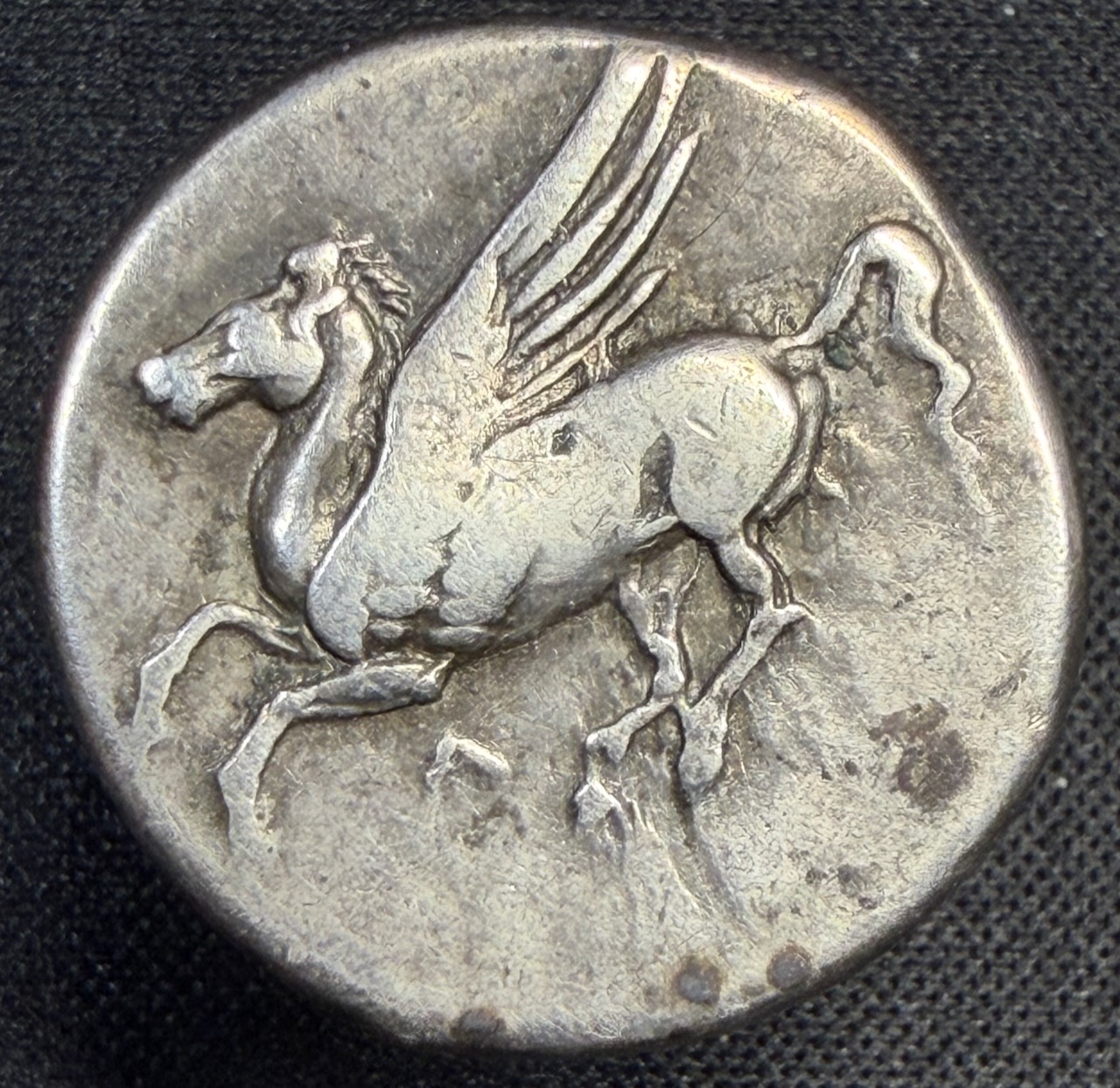
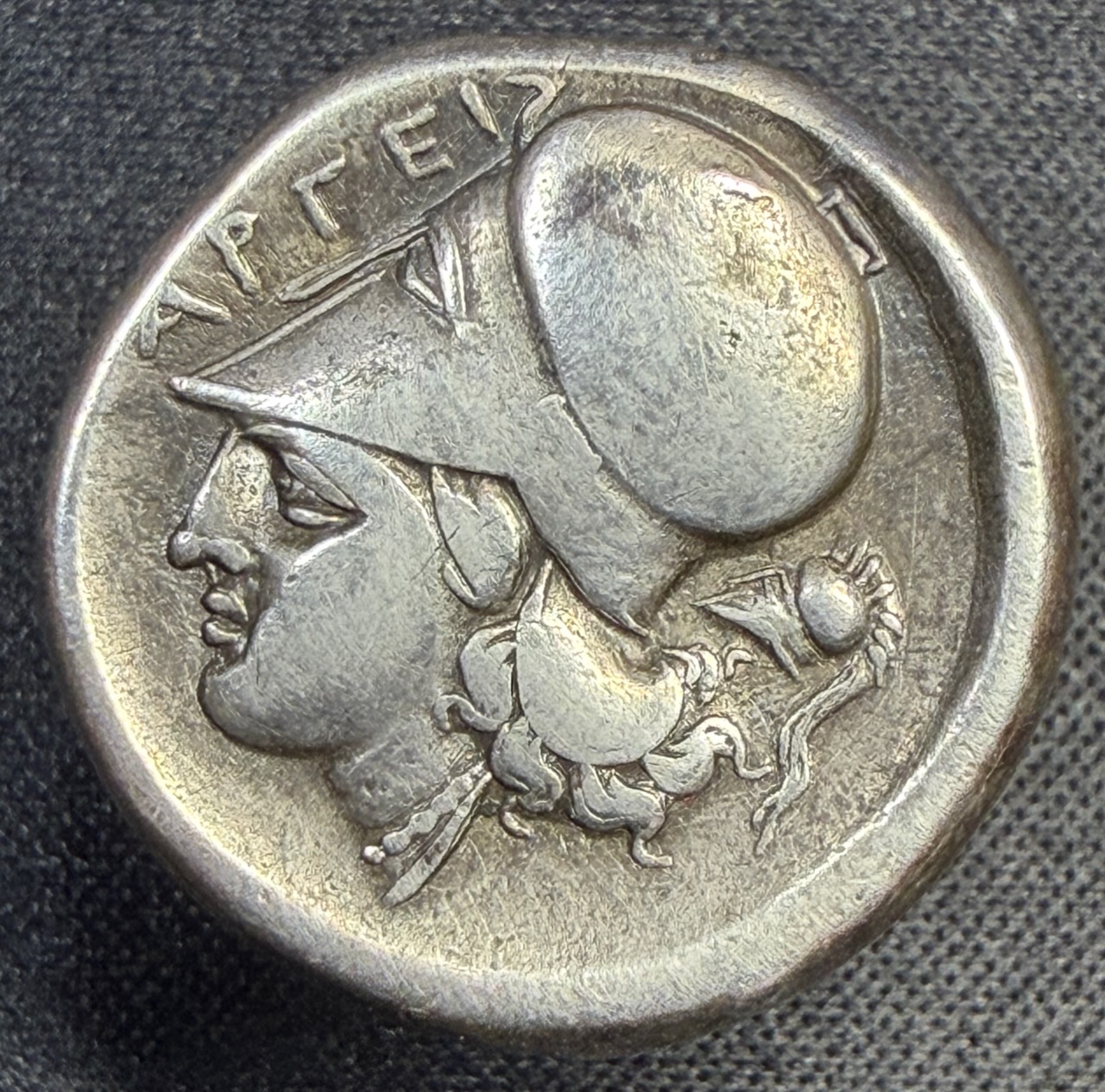
Current: Akarnania, Argos Amphilochikon. AR stater, c. 350–270 BC (dealer tag; standard catalogues bracket the city's staters c. 360–300 BC). Pegasos with pointed wing flying left, A below / head of Athena left in Corinthian helmet, ΑΡΓΕΙ and symbol behind. Sear (Greek) 2258.
Obverse: Pegasos with pointed wing flying left; below, A — the initial of Argos, in the position where Corinth's own staters carry the koppa
Reverse: Head of Athena left, wearing Corinthian helmet; ΑΡΓΕΙ (abbreviating the ethnic) and symbol behind
Primary reference: Sear (Greek) 2258
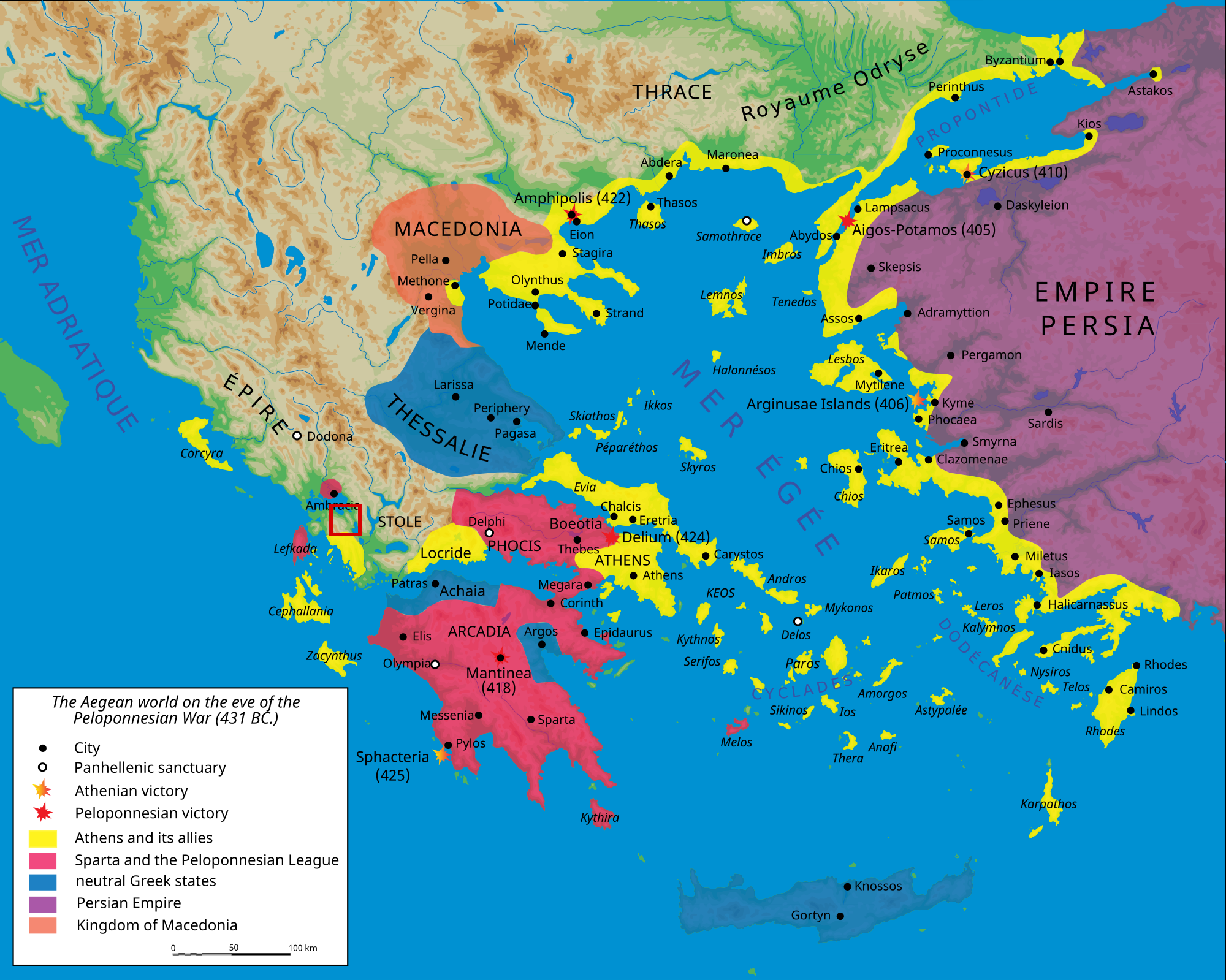
The Greek world on the eve of the Peloponnesian War (431 BC). The red square marks Argos Amphilochikon, at the inner (eastern) corner of the Ambracian Gulf in northwest Greece, with its neighbor and rival Ambracia — Corinth’s great colony — just to the north. This is the Corinthian colonial northwest whose cities struck the shared ‘pegasi’ coinage; Corinth itself, mother of the currency, lies at the Isthmus to the southeast. (The map shows the political world of 431 BC, two or three generations before this stater was struck; the geography of the pegasi network is unchanged.)
“Map of the Peloponnesian War, 431 BC” by Marsyas, English version by Aeonx (Wikimedia Commons), File:Map Peloponnesian War 431 BC-en.svg, licensed CC BY-SA 3.0 (https://commons.wikimedia.org/wiki/File:Map_Peloponnesian_War_431_BC-en.svg; license: https://creativecommons.org/licenses/by-sa/3.0/). Rasterized from SVG to PNG by JSB Coins; a red square has been added to mark the position of Argos Amphilochikon. This derivative is shared under the same CC BY-SA 3.0 license.
This stater is a “colt” — a Corinthian-type Pegasos stater — but not from Corinth: it was struck at Argos Amphilochikon, a small city at the head of the Ambracian Gulf in northwest Greece, and it is a fine example of how Corinth’s coinage became the shared currency of an entire region. The collection’s early Corinth stater shows the coinage at its source; this coin shows the network it created.
The city’s double name preserves its legend. Greek tradition held that it was founded by Amphilochos, son of the great seer Amphiaraos of Argos in the Peloponnese, returning from the Trojan War — hence “the Argos of the Amphilochians,” distinguishing it from its famous namesake. It lay on the eastern shore of the Ambracian Gulf, in the borderland between Akarnania and Epeiros, with Corinth’s powerful colony Ambracia as neighbor and frequent enemy. Thucydides (2.68) tells its fifth-century story: squeezed by the Ambraciots, the Amphilochians called in the Akarnanians and the Athenians, and the city became a member of the Akarnanian world — Greek-speaking, Thucydides notes, only from its long association with its Argive founders’ descendants and neighbors.
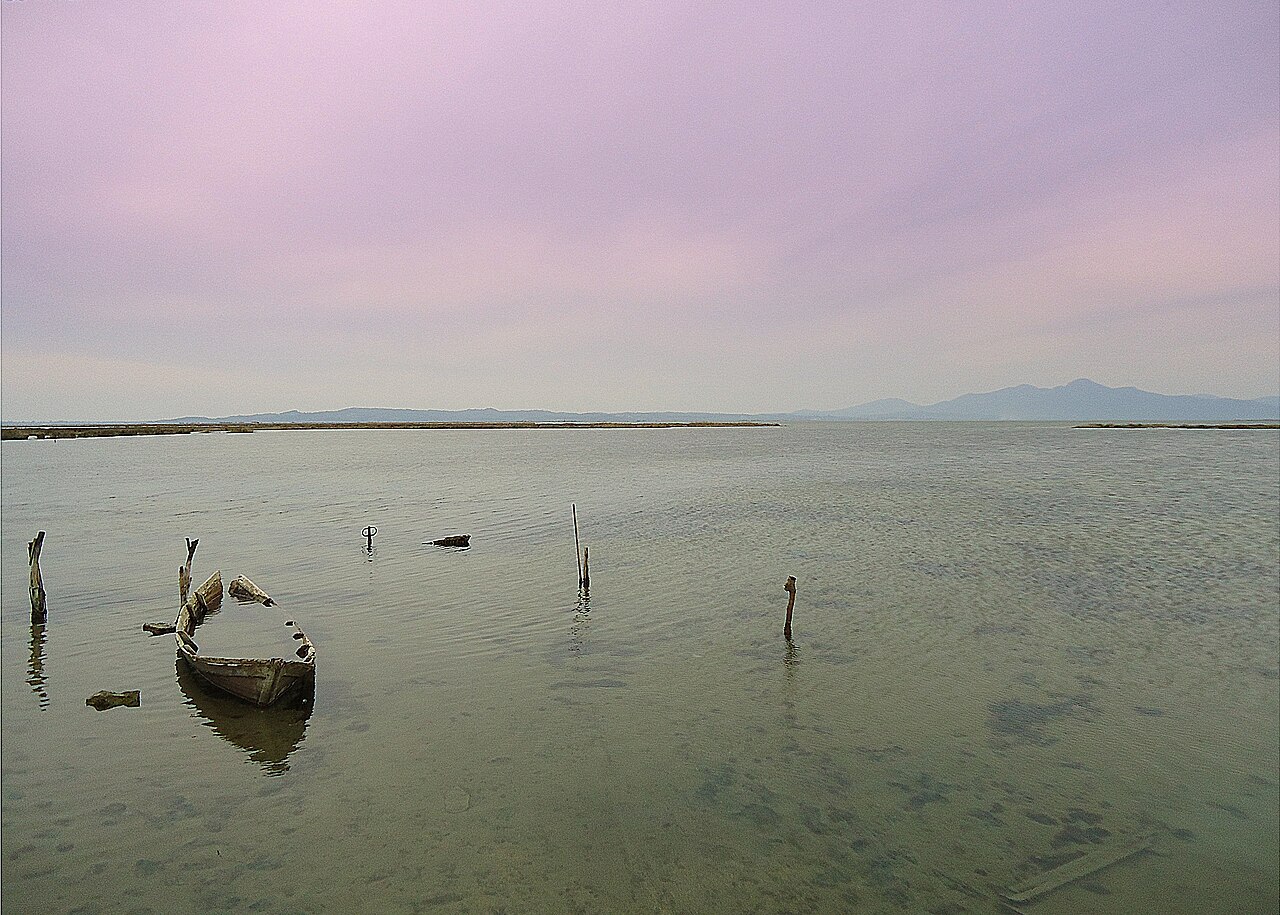
Photo: ArtaMania, Wikimedia Commons, licensed CC BY-SA 4.0, reproduced unmodified.
For a few months in 426/5 BC this small city stood at the center of the Peloponnesian War. Ambracia, backed by a Peloponnesian force under the Spartan Eurylochos, marched on Amphilochian Argos; the Akarnanians summoned the Athenian general Demosthenes, and at Olpae, on the gulf shore in Argive territory, he beat the coalition with an ambush — Eurylochos fell on the field. Days later, at the hill of Idomene, Demosthenes surprised the Ambraciot reinforcements asleep and destroyed them; Thucydides, who tells the whole campaign in one of his finest sustained narratives (3.105–114), refuses to record the number of dead as past belief for so small a city, and calls it the greatest disaster to befall any Greek city in so few days in the entire war. The peace that followed was a masterpiece of small-state realism: Amphilochians and Ambraciots swore a hundred-year local treaty binding neither to the great powers’ wars — each side, in effect, resigning from the Peloponnesian War by contract. The coin in this collection was struck two or three generations later, when the gulf’s cities had settled into the shared prosperity the pegasi currency serviced.
From the later fifth century and above all in the fourth, Corinth and a widening circle of colonial and allied mints across northwest Greece — Ambracia, Leukas, Anaktorion, Thyrrheion, and others — struck staters of identical type and weight: Pegasos on one side, the helmeted head of Athena on the other, differing only in the mint letter and local symbols. The result was a genuinely common currency, the pegasi, that served the trade of the Corinthian Gulf, the Adriatic coast, and the routes to Italy and Sicily. Enormous quantities were absorbed by Sicily in the era of Timoleon, the Corinthian liberator of Syracuse (344–337 BC), whose expedition and resettlement of the island were financed largely in pegasi — Sicilian hoards of the period are full of them, and they anchor the dating of the whole series. Argos Amphilochikon was one of the smaller members of this network: its staters carry the A beneath Pegasos and the ethnic ΑΡΓΕΙ behind Athena, and they are distinctly scarcer than the issues of Corinth, Ambracia, or Leukas.
The types are Corinth’s, borrowed whole: Pegasos, here with the pointed wing of the later style, flying left above the city’s initial; and Athena in the Corinthian helmet — the goddess who bridled Pegasos at Corinth’s spring of Peirene — facing left, with the abbreviated ethnic and a control symbol behind her. The uniformity was the point: a merchant in Sicily or Epeiros took an Amphilochian colt at par with a Corinthian one because they were the same coin in everything but the small letters.
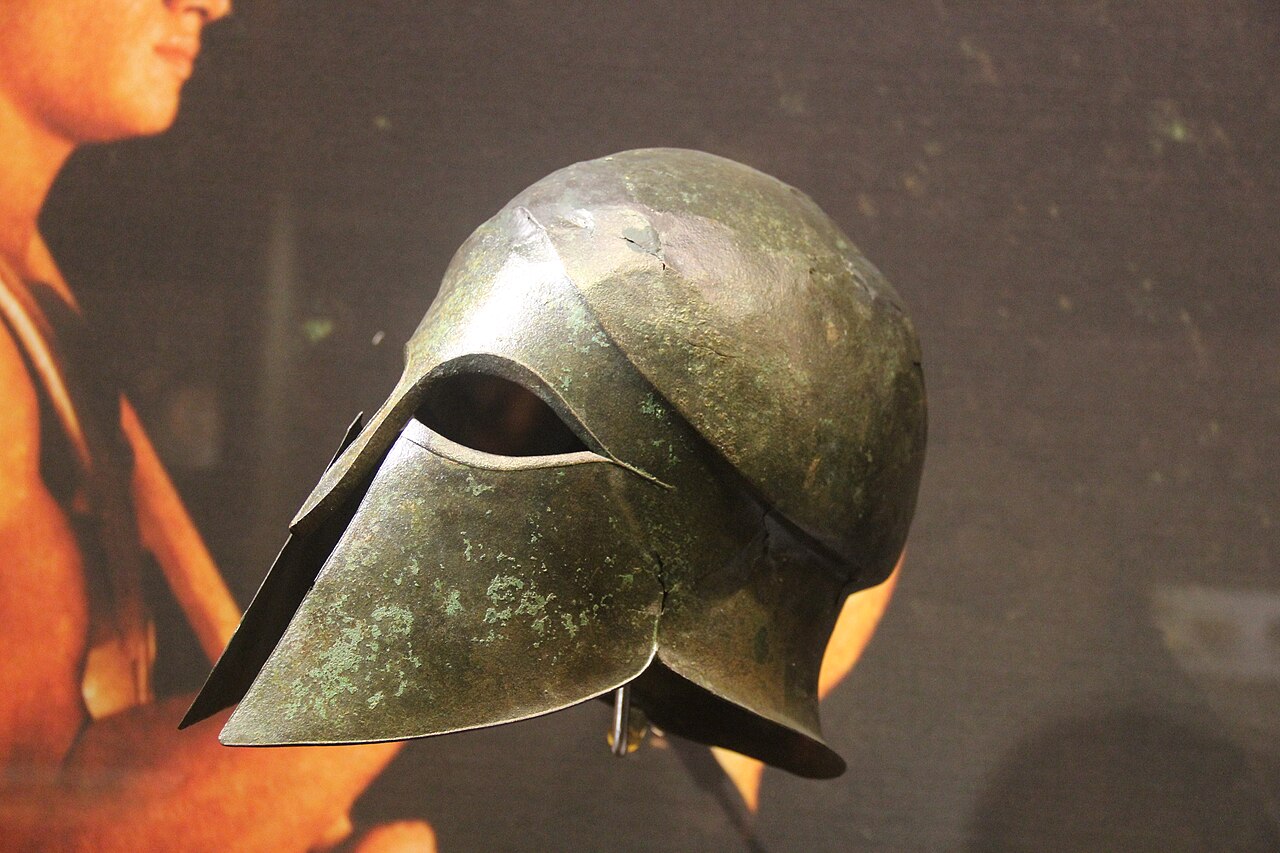
Photo: Gary Todd, Wikimedia Commons, CC0; reproduced unmodified.
The dealer tag gives c. 350–270 BC; current catalogues generally bracket the city’s staters c. 360–330 or 340–300 BC. The pegasi of the northwestern mints are dated mainly by hoard evidence — above all the Sicilian hoards of the Timoleonic era — and the fine chronology of the smaller mints remains approximate. The broad picture is secure: this is money of the later fourth century’s great pegasi boom, tailing into the early third.
Beside the collection’s Corinth stater, this coin completes a pair: the mother coinage and its colonial echo, struck perhaps a century and a half apart, same types, same standard, different city. Few pairings show so cleanly how a Greek civic coinage could become an international currency — and how a small Akarnanian town could plug itself into Mediterranean trade by minting another city’s images.
The dealer’s reference is Sear, Greek Coins and Their Values I, no. 2258; the standard corpus for the pegasi mints is R. Calciati, Pegasi (1990), vol. II for the colonial issues, with the BCD Akarnania sale catalogue (Lanz, 2007) as the fullest modern reference for the region — the specimen’s Calciati number awaits identification of the reverse symbol. Current auction catalogues (CNG, Nomos) bracket the city’s staters c. 360–330/340–300 BC. Historical sources: Thucydides 2.68 (the city’s foundation legend and fifth-century history) and 3.105–114 (Olpae and Idomene, with the hundred-year treaty at 3.114); on Timoleon and the pegasi in Sicily, Plutarch’s Timoleon with the hoard evidence summarized in the numismatic handbooks (Kraay, Archaic and Classical Greek Coins).
Struck on the Corinthian standard (stater c. 8.4–8.6 g) as part of the great 'pegasi' currency network — Corinthian-type staters issued by Corinth and by allied and colonial mints of northwest Greece and the Adriatic coast, mutually interchangeable and distinguished by mint letters: Corinth's koppa, Ambracia's A... and here the A of Amphilochian Argos with the ethnic ΑΡΓΕΙ on the reverse. The dealer tag's date (350–270 BC) is broader than the c. 360–330/340–300 BC brackets in current catalogues; the pegasi of the northwestern mints are dated largely by hoards, many connected with Timoleon's Sicilian expedition and its aftermath, and precision is limited. The reverse symbol behind Athena on this specimen needs identification to fix the Calciati (Pegasi) number.
John's Ancient Coin Collection · Type · argos-amphilochikon-pegasos-stater
Image credits for this coin — photographs, maps and graphics used on this page

_gulf,_Arta,_Epirus,_Greece_1.jpg)
