In the last winter of the Roman Republic, Mark Antony struck a coin for every legion in his army — a galley on one face, an eagle between two standards on the other, and a legion's number where an emperor's head would soon go. This collection is gathering one denarius for every legion he named.
By the autumn of 32 BC the Roman world had run out of room for two men. Octavian held Italy and the West; Antony held everything from Greece to the Euphrates, with Cleopatra's Egypt behind him. War had been declared — formally against Cleopatra, because a civil war was easier to sell as a foreign one — and Antony moved his whole apparatus to Greece and settled into winter quarters at Patrae, on the Gulf of Corinth's northwest corner.
What he had with him was enormous: the sources describe a fleet of some five hundred ships and an army drawn from across the Roman East. What he did not have was money in coin. Fleets and legions are paid in silver, pay was due through the winter, and the treasure Cleopatra brought needed to become denarii — millions of them, quickly, from a mint that travelled with the army.
The answer is the coinage this page is about, and it is one of the largest single coinages the ancient world ever produced. Dio says flatly that Antony was the better funded of the two (50.18.2), and the hoards agree: comparing how often each side's coins turn up, Antony's war coinage may have been as much as ten times the size of Octavian's (Dillon, cited in Rowan). What is certain is that a century after Actium these coins still made up around a fifth of the denarii circulating in Greece, and worn examples were still turning up in hoards in the third century AD.
Why there is no portrait
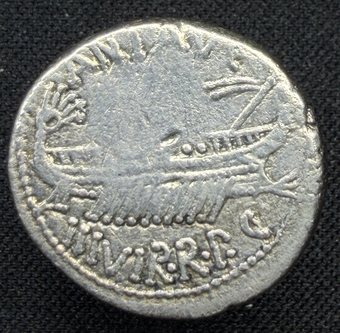
Antony had put his own head on coins for a decade, and Cleopatra's beside it. On this, the biggest issue of his life, he put neither. The obverse is his flagship; the reverse is the army's own cult objects; the legend is just ANT·AVG III·VIR·R·P·C — "Antony, augur, triumvir for the restoration of the Republic." The coin flatters nobody but the men being paid with it. There is a sharper reading too: Octavian's whole case for war was that Antony had gone eastern — bewitched by a queen, half a Hellenistic king already — and Clare Rowan suggests this defiantly un-Hellenistic imagery is the answer to it: no royal portrait, just Roman ships and Roman standards, a “monument in miniature” spelling out, legion by legion, exactly how much force stood behind him. And there is a wrinkle in the legend itself: the triumvirate had legally expired in 33 BC. The title Antony claims on every one of these coins was one he no longer held.
II
Galley, eagle, standards
The obverse, from the collection's own LEG X denarius: a praetorian galley under oar — Antony's flagship, standing for the five hundred ships wintering at Patrae and Actium. Catalogue entry →
The reverse is the army in three objects: the aquila — the legion's eagle, the object Pliny says was made the legions' alone, whose loss was the deepest disgrace a unit could suffer — between two signa, the standards of the centuries. Above or below runs the number: LEG III, LEG X, LEG XXI, from LEG PRI (the "first legion", written out) to LEG XXIII, with a handful of legions given names as well as numbers, and two issues for cohorts that were not legions at all.
Crawford catalogues the whole series as RRC 544 — thirty-nine issues once the variants are counted, struck "at a mint moving with Antony," conventionally placed at Patrae. Nineteen-plus legion numbers, struck at speed, on flans that were often a little ragged, from dies cut by hands of very mixed skill: this is money made under pressure, and it looks it. That is a large part of its appeal. This is not a medallion for a triumph; it is a pay packet for a war that was about to be lost.
One romantic idea has to go, though: the hoards show the different legion types thoroughly mixed together — the Actium hoard is 93% legionary denarii, of assorted legions — so the coins were almost certainly paid out at random, not each legion with its own number (Keppie). The Tenth was not paid in LEG X. The numbers were the army's portrait, not its payroll ledger.
In the collection · the first two of twenty-fivetap a coin for its catalogue entry
The matching series in Africa
Antony's lieutenant Pinarius Scarpus, holding Cyrenaica, struck his own small echo of the series: the same aquila-between-standards reverse naming the eighth legion, under an obverse of Jupiter Ammon (RRC 546/1). After Actium, Scarpus changed sides without blinking and struck for Octavian instead — the whole civil war in one man's mint output.
III
The silver, and the three-hundred-year consequence
Analysis puts the legionary denarii at about 92.2% silver against 96.84% for Octavian's contemporary issues. The easy story is that a desperate mint stretched the metal — but the likelier explanation, Rowan argues, is more interesting: 92% is roughly the fineness of the cistophori, the local silver standard of the Roman East where this army had been paid for years. Antony's mint was conforming to the money his soldiers already knew. Either way the difference was invisible to the eye — and either way, the market found it out.
Bad money drives out good: the legionary denarius is the ancient world's best demonstration of Gresham's law, three centuries long.
Because everyone eventually knew these coins ran a little light, everyone spent them and hoarded something else. So the good coins vanished into the ground and the legionary denarii stayed out in the world, doing work, for three hundred years — rubbed slick, tested with banker's punches (the collection's LEG III carries one), and still officially acceptable currency into the Severan era. When Marcus Aurelius' treasury officials pulled worn silver from circulation in the 160s AD, legionary denarii were still coming in through the door. The extreme case is the Shapwick villa hoard from Roman Britain, buried in the third century AD with 260 legionary denarii in it — many worn nearly to blank discs, two hundred and fifty years' work showing on their faces.
The fuller story of Rome's silver — where Antony's ninety-two percent sits on a six-century slide — is told in this site's The Silver Goes Bad; the banker's punches these coins so often carry have their own page in Test cuts and bankers.
Struck onto one coin
In CNG's electronic sale 615 (August 2026) there is a legionary denarius of LEG II carrying a countermark of Vespasian — IMP·VES punched into the silver around AD 74–79, a hundred years and thirteen emperors after Actium, to certify that Antony's coin was still good to spend. One object, carrying the whole argument of this section.
IV
The legion wall — one coin for every legion
This is the collection's standing project: one legionary denarius for every legion Antony named — the twenty-three numbered legions, plus the two cohort issues as extra credit. Bronze-ringed discs are coins in the collection; the engraved discs are still wanted. Each slot links to its coin's page here, or — for the legions still missing — to the type's page in the American Numismatic Society's Coinage of the Roman Republic Online.
LEG III, LEG X (bronze-ringed): the collection's own coins, photographed by the owner.
All other coin photographs are reference specimens from the collection of the American Numismatic Society, via Coinage of the Roman Republic Online; ANS images of ancient objects carry the Public Domain Mark. They show each type's reverse, not coins in this collection. Accessions: LEG II 1944.100.6312 · LEG IIII 1944.100.6316 · LEG V 1944.100.6319 · LEG VI 1944.100.6320 · LEG VII 1944.100.6321 · LEG VIII 1944.100.6323 · LEG IX (VIIII) 1978.71.1 · LEG XI 1944.100.6326 · LEG XII (ANTIQVAE) 1944.100.6307 · LEG XIII 1956.163.42 · LEG XIV 1944.100.6329 · LEG XV 1944.100.6330 · LEG XVI 1944.100.6331 · LEG XVII (CLASSICAE) 1944.100.6308 · LEG XVIII (LYBICAE) 1944.100.6309 · LEG XIX 1944.100.6333 · LEG XX 1944.100.6334 · LEG XXI 1944.100.6335 · LEG XXII 1944.100.6336 · LEG XXIII 1944.100.6337 · CHORTIS SPECVLATORVM 1944.100.6311.
LEG PRI and CHORTIVM PRAETORIARVM keep their engraved placeholder discs: the ANS holds no reverse photograph of either (RRC 544/13 and 544/1), which is itself a statement about how rare the two hardest slots are. A credited auction photograph will stand in when one surfaces — likely the same day a biddable example does.
It is tempting to read the wall as a muster roll of famous names — but honesty first: most of Antony's numbered legions cannot be securely matched to the named legions of the later empire. Both Antony and Octavian numbered their legions from I upward, so in 31 BC there were two Legio VIs, two Legio Xs, and so on, facing each other across the Ambracian Gulf; after Actium the victor amalgamated, renumbered and resettled, and the threads tangle. The identifications scholars do argue for — Keppie's work is the standard treatment — are flagged on the wall as "possibly," and left there.
Issue
What can actually be said
LEG PRI
The "first legion," written PRI rather than I — and scarce, perhaps because the honorific first legion existed more on paper than in the line.
LEG III
Sometimes linked to III Gallica, raised by Caesar in Gaul, which fought for Antony at Philippi and in Parthia. In the collection.
LEG V
Plausibly V Alaudae, "the Larks" — Caesar's Gaulish legion, whose men wore lark's wings on their helmets.
LEG VI
The number both warlords held: Antony's VI became Ferrata, "Ironclad," in the East; Octavian's became VI Victrix. Two hundred years later it was LEG VI that the emperors chose when they re-struck this coinage (below).
LEG X
The number Caesar made famous — his favourite, the Tenth, whose men he once shamed back into line by addressing them as "citizens." Whether Antony's X contained those veterans is exactly the kind of thread that cannot be pulled tight. In the collection.
XII ANTIQVAE · XVII CLASSICAE · XVIII LYBICAE
The three legions given names on the coins themselves: "the Old Twelfth," "the Fleet Seventeenth," "the Libyan Eighteenth" — unit pride cast in silver, and all three scarcer than the plain numbers.
CHORTIS SPECVLATORVM
The corps of scouts, couriers and — the word's later career — secret police of the headquarters. Its reverse swaps the aquila for three naval standards decorated with rostra: a fleet army's badge. Rare (Crawford 544/12).
CHORTIVM PRAETORIARVM
The praetorian cohorts — the commander's guard, a generation before Augustus made the name notorious. Rare.
The high numbers
LEG XXI, XXII and XXIII are the scarce end of the series: the highest-numbered formations were the smallest issues. The collection's want list flags these specifically.
V
After Actium
On 2 September 31 BC the fleets met off Actium, and by the following summer Antony and Cleopatra were dead in Alexandria. The army the coins had paid mostly never fought: legion after legion went over to Octavian or surrendered in place, and the victor faced the oldest post-war problem — too many legions, all owed land. Antony's men and Octavian's were demobilised and settled side by side; some of Antony's formations were kept whole under new management; the doubled numbers were resolved, untidily, into the imperial army list.
And then the best documented irony in the whole story: Octavian appears to have paid his own discharged veterans with Antony's money. At Ateste — a colony Octavian founded for his veterans — a hoard closed under Augustus contains fifty of Antony's legionary denarii against just two of Octavian's own contemporary issues. The victor had captured the loser's treasury, and re-striking it was a losing proposition: improve the debased silver to Rome's standard and you end up with fewer coins than you started with. So the coins of the erased man kept flowing — from the hands of the state that erased him (Dillon, cited in Rowan). It helped that the war had officially been against Cleopatra, and that these coins carried no portrait to be embarrassed about.
The coins outlived the army. And then, two hundred years to the year after Actium, the coinage received the strangest compliment in Roman numismatics: in AD 169 Marcus Aurelius and Lucius Verus issued a restoration of the legionary denarius — same galley, same eagle and standards, marked LEG VI, with ANTONIVS spelled out in full so that no one would read the abbreviated name as their own dynasty's "Antoninus." The reverse adds ANTONINVS ET VERVS AVG REST — “restored,” the same abbreviation emperors put on rebuilt temples; Rowan's phrase is exact: the coin was restored as a monument (RIC III Marcus Aurelius 443). An emperor-philosopher reminting the coinage of the man Augustus had erased: partly a gesture to the Sixth's own bicentennial pride, partly an admission that after two centuries the old legionary denarii were still such familiar money that their replacement had to look like them.
Clare Rowan, From Caesar to Augustus (c. 49 BC–AD 14): Using Coins as Sources (Cambridge, 2019), ch. 4.6 — the modern treatment this page leans on most: the “monument in miniature” reading, the expired-triumvirate legend, the cistophoric explanation of the fineness, the Actium/Delos/Ateste hoards, Scarpus’ matching series, and the restoration issue. Consulted in the collection’s own copy.
M. H. Crawford, Roman Republican Coinage (1974), no. 544; with B. Woytek (2007) 503–18 — the standard catalogues; subnumbers on the wall follow RRC.
L. J. F. Keppie, The Making of the Roman Army (1984) and Legions and Veterans (2000) — the standard treatment of Antony's legions and the post-Actium settlement, and the source of the caution urged above.
Plutarch, Life of Antony; Cassius Dio, book L — the campaign, the fleet, and the winter at Patrae.
Pliny, Natural History X.16 — the eagle assigned to the legions alone.
Woytek / Kroll / Lockyear; Dillon; Abdy & Minnitt (largely as cited in Rowan) — circulation share, hoard evidence, relative issue sizes, and the Shapwick hoard; a convenient survey also in Legionary denarii (Wikipedia), with the metallurgy (92.2% vs 96.84%).
Where the argument is still open: the identification of Antony's numbered legions with later imperial legions is contested throughout and presented here as such; the size of the original issue is a modern estimate, not an ancient figure; and the mint is "Patrae(?)" in every honest catalogue — a mint moving with an army leaves no address.
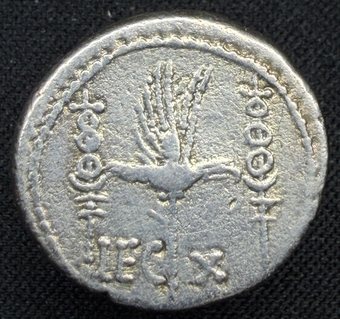 LEG X · the collection’s own
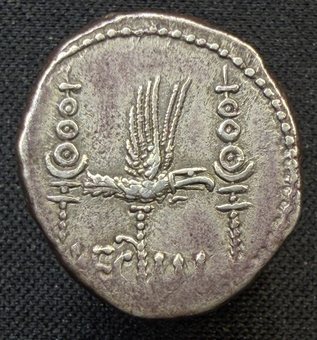 LEG III