In the spring of 334 BC a twenty-one-year-old king led some 37,000 Macedonians and Greeks across the Hellespont into Asia. He threw a spear into the shore as he landed, and claimed the continent as spear-won land. Eleven years later he was dead in Babylon at thirty-two, master of everything from the Adriatic to the Punjab, having never lost a battle. No one in antiquity, and few since, has matched what Alexander III of Macedon did in that span; and no one until the Romans matched what he did to the money.
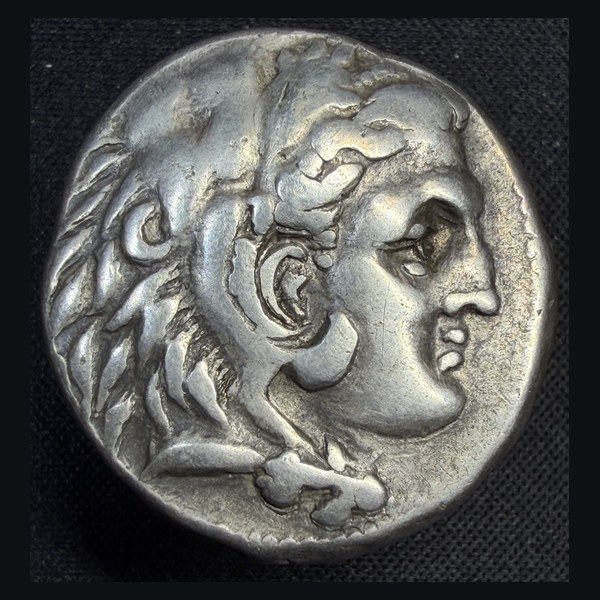
Because Alexander's conquest was, before anything else, a monetary event. He inherited a kingdom that had only struck serious silver for a generation; he captured the treasuries of the Persian empire — something like 180,000 talents of bullion, by Strabo's reckoning — and he turned that hoard into coin on a scale the ancient world had never seen. The silver tetradrachm he introduced, with the head of Herakles in a lion-skin on one face and Zeus enthroned on the other, became the common currency of the eastern Mediterranean. Cities were still striking it, in his name, two hundred years after his death.
This collection holds four coins struck in Alexander's name — a tetradrachm from Amphipolis, one from Kolophon, a drachm probably from Sardes, and a bronze of his lifetime — together with the older money of the world he conquered and the new money of the kings who divided it. This essay sets them in order: the world he inherited, the war he fought, the coinage he made, and the world he left.
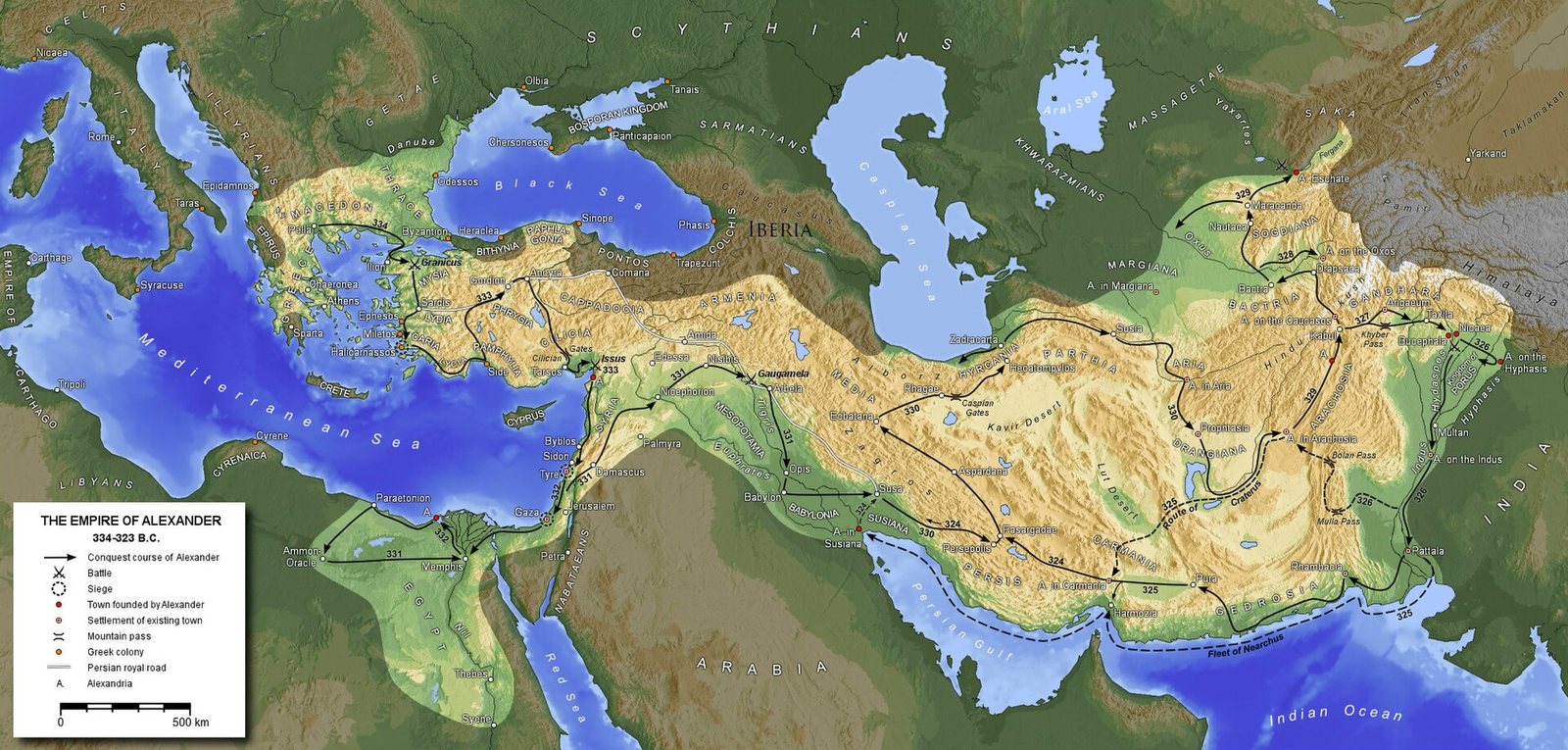
Image source & licence
Map: “MacedonEmpire.jpg”, produced with Generic Mapping Tools, via Wikimedia Commons. CC BY-SA 3.0.
The world he inherited
Persia: the Great King's money
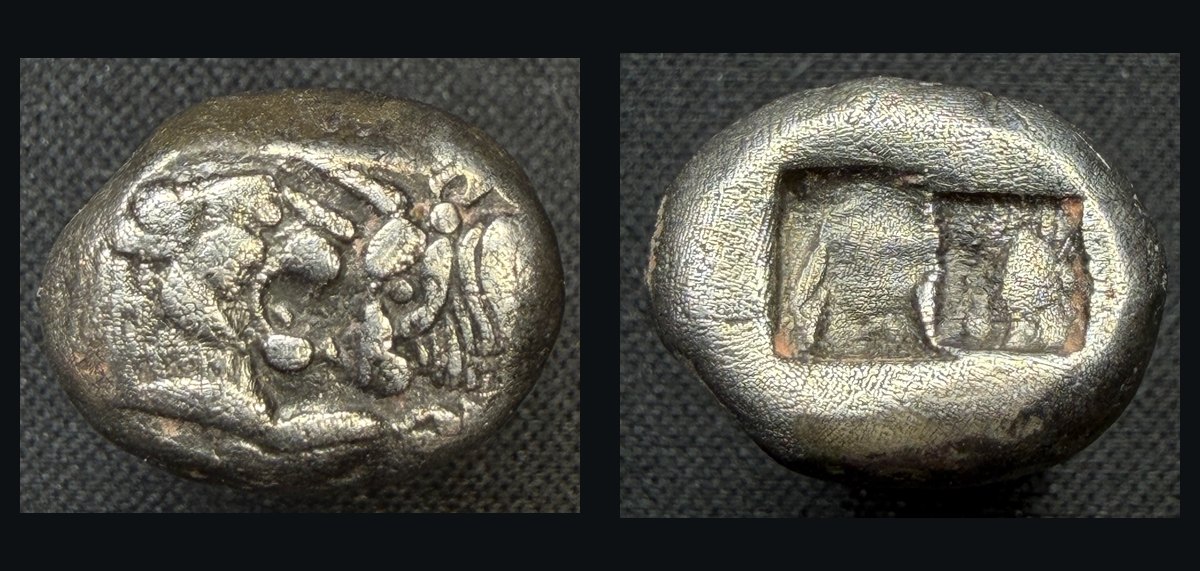
The empire Alexander set out to conquer was the largest the world had yet seen, and it had been using coined money for two centuries before he was born. Coinage itself was invented in Lydia, in western Asia Minor, in the seventh century BC; its last native king, Croesus, struck the first bimetallic system of pure gold and pure silver, with a lion and bull confronted on the obverse. When Cyrus the Great took Sardes in about 546 BC the Persians simply carried on striking Croesus's types — the lion-and-bull siglos in this collection belongs to that Persian continuation, a decade or two after the conquest.
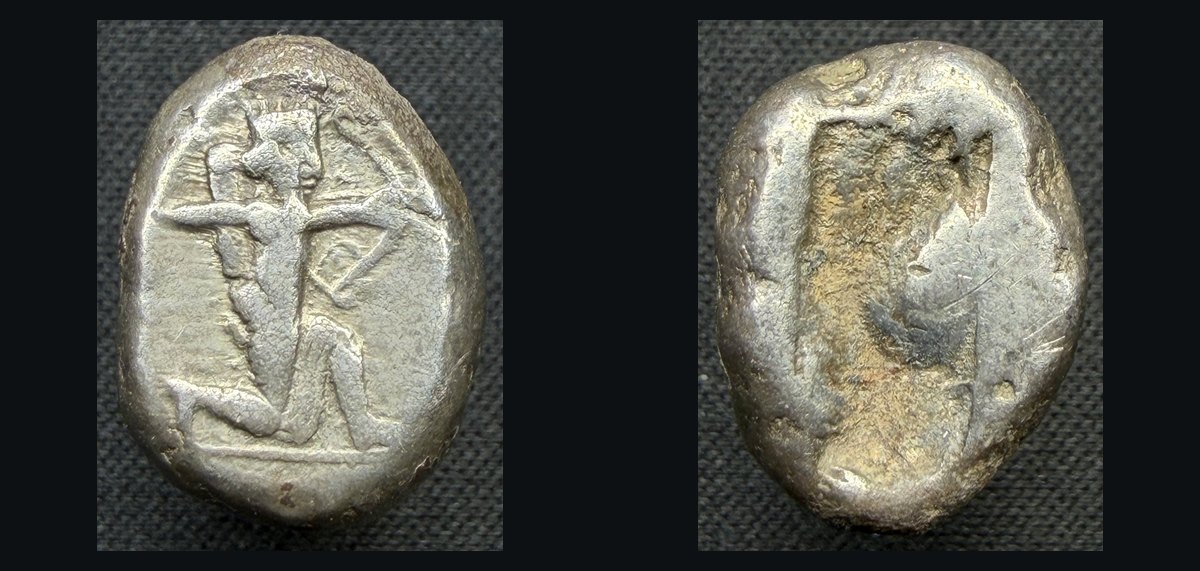
Around 520–500 BC Darius I replaced the Lydian types with his own: the daric in gold and the siglos in silver, both showing the Great King as a running archer. These were struck at Sardes for the western satrapies — the Persian heartland barely used coin at all, keeping its wealth as bullion in the treasuries at Susa, Persepolis and Ecbatana. That distinction mattered enormously in 331 BC. When Alexander broke into those treasuries he found not coin but metal, and had to make the coin himself.
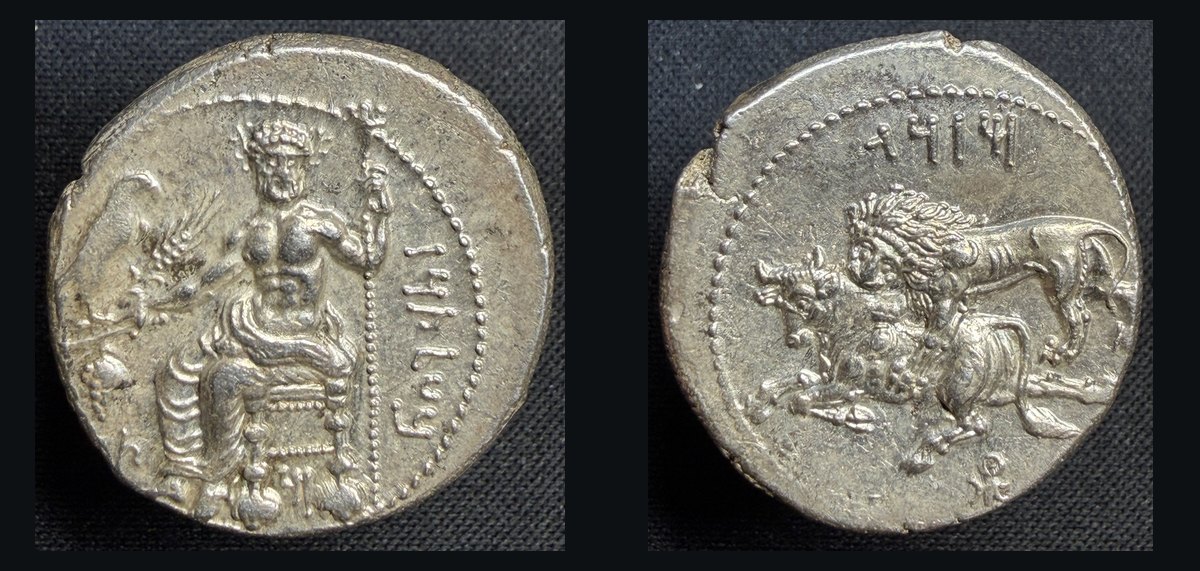
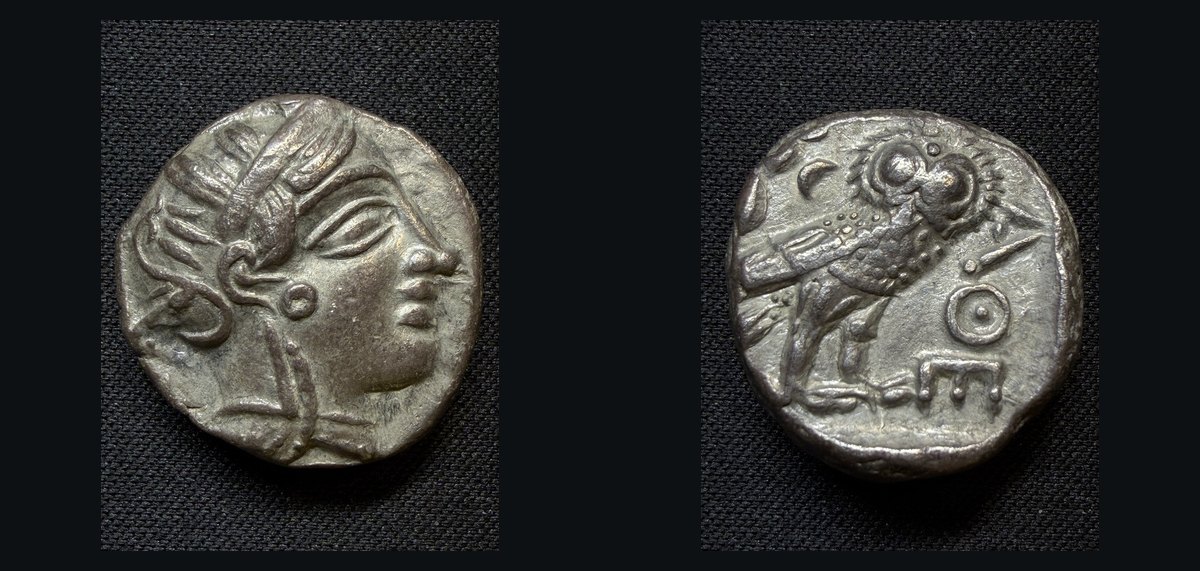
By the fourth century the Persian west was a patchwork of currencies. The satraps struck their own silver; the Phoenician and Cilician cities struck theirs; and everywhere the Athenian owl circulated as the international trade coin, so trusted that Egypt — in revolt from Persia for most of the fourth century — struck its own imitation owls to pay Greek mercenaries. The most important of the satrapal coinages, for our story, was that of Mazaios, satrap of Cilicia, who struck a large silver stater at Tarsos showing the local Baal enthroned with a sceptre. Keep that image in mind: Alexander's mint-masters would.
Athens: the owl that everybody trusted
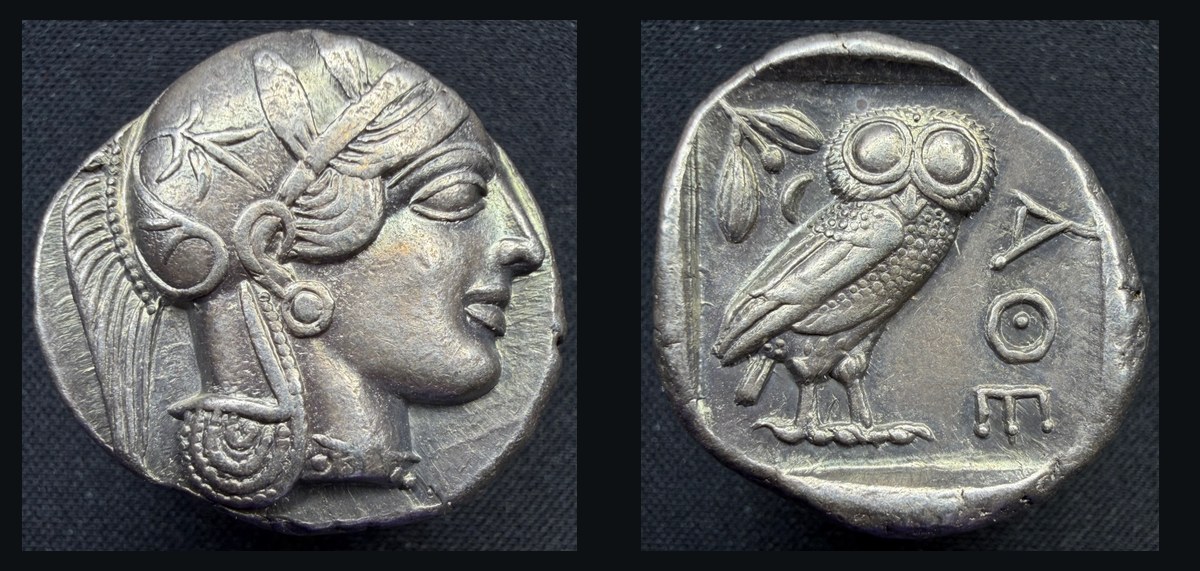
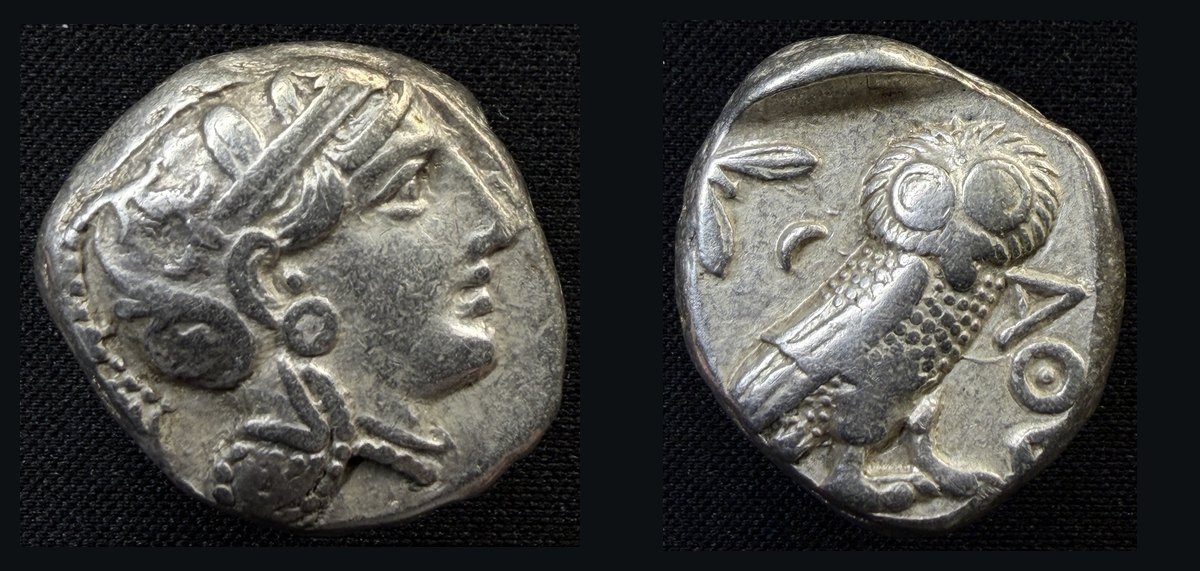
The Athenian tetradrachm — helmeted Athena on one side, her owl on the other — was the dollar of the classical Aegean. Athens struck it in enormous quantities from the silver of Laurion, kept its weight (about 17.2 g) and fineness unchanged for two centuries, and deliberately never modernised its archaic style, because merchants from Sicily to the Indus knew exactly what an owl looked like and did not want it to change. Alexander adopted the Athenian Attic weight standard for his own silver, which is the single most important reason his coinage went international so fast: an Alexander tetradrachm was interchangeable with an owl.
Philip II: the father who built the machine
Alexander's achievement is unthinkable without his father's. When Philip II took the throne of Macedon in 359 BC the kingdom was a semi-barbarous backwater on the northern edge of the Greek world, its last king dead on a battlefield along with four thousand men. In twenty-three years Philip made it the master of Greece. He reformed the army around the sarissa-armed phalanx and a heavy shock cavalry, the Companions; he seized the gold and silver mines of Mount Pangaion, worth a thousand talents a year; he took Amphipolis (357) and made it his principal mint; and at Chaeronea in 338 BC he broke the combined army of Athens and Thebes. The eighteen-year-old Alexander led the decisive cavalry charge.
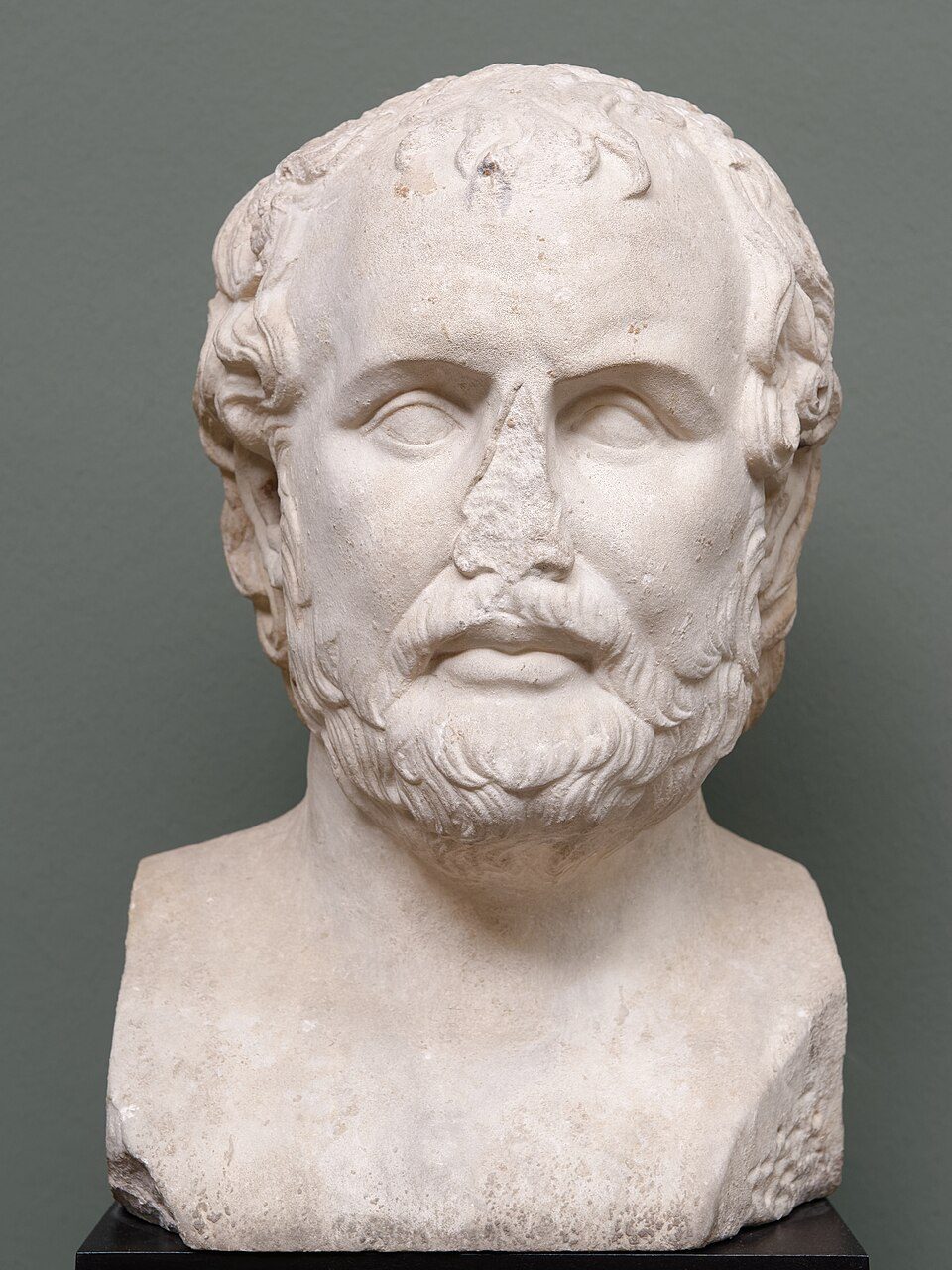
Image source & licence
Photo: Jastrow (Marie-Lan Nguyen), Ny Carlsberg Glyptotek IN 2263, via Wikimedia Commons. CC BY 4.0.
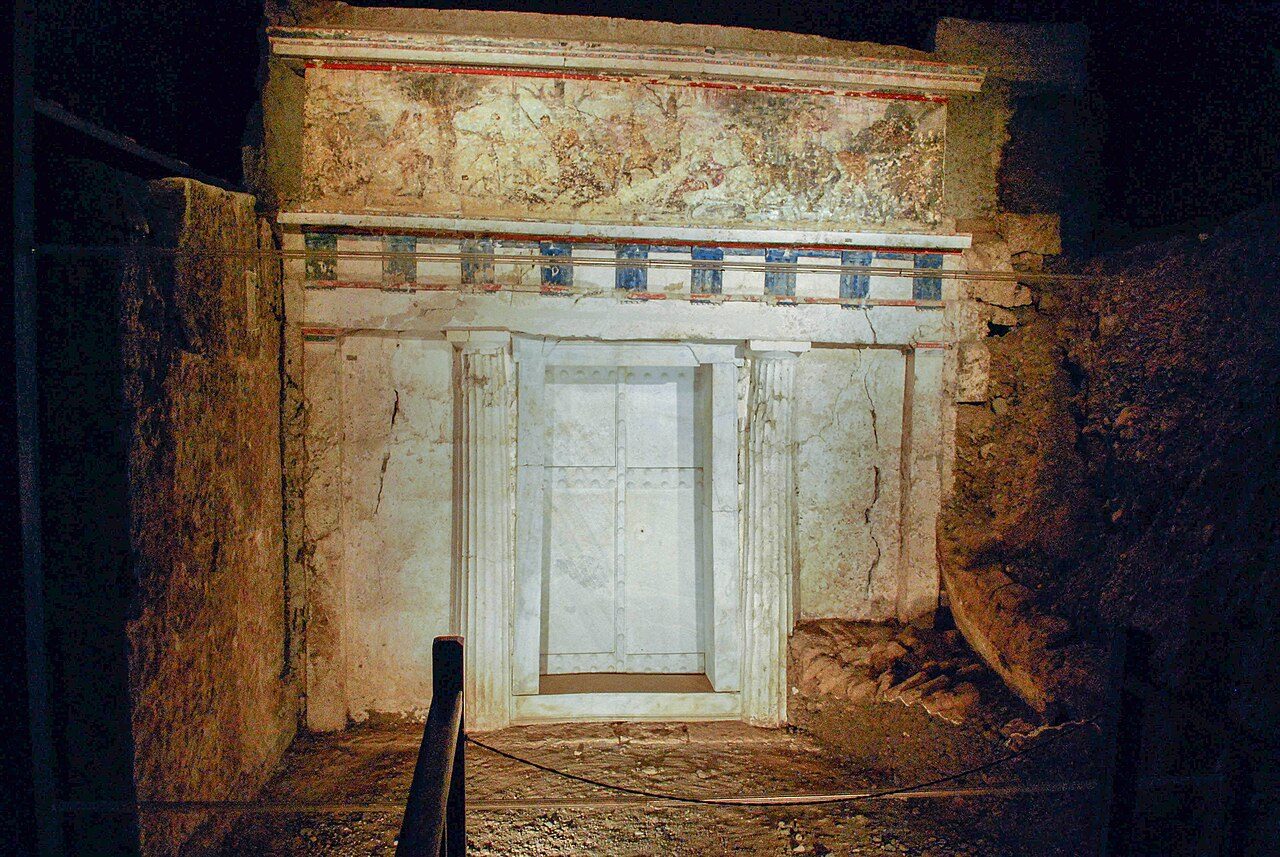
Image source & licence
Photo: Sarah Murray (“Panegyrics of Granovetter”), via Wikimedia Commons. Released into the public domain by the author.
Philip also gave Macedon its first great coinage. His gold stater — head of Apollo / two-horse racing chariot, commemorating his Olympic victory of 356, the year of Alexander's birth — was struck on the Attic standard from Pangaion gold and became the first gold coin to circulate widely in Greece and beyond; Celtic tribes as far as Britain were imitating it for centuries. His silver tetradrachm, on the heavier local standard, showed Zeus and a horseman. Both continued to be struck long after his murder in 336.
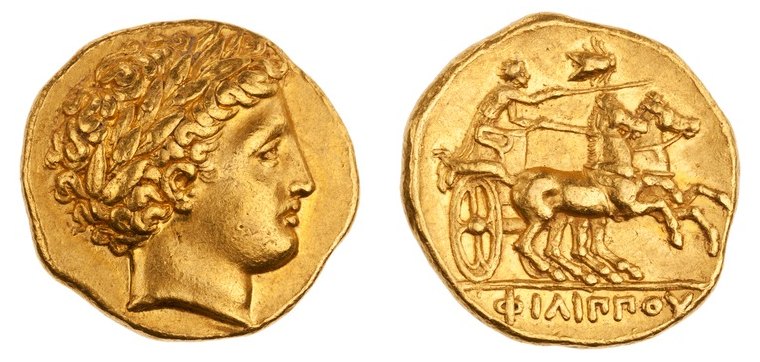
Image source & licence
Coin: American Numismatic Society, 1944.100.12024. Public domain.
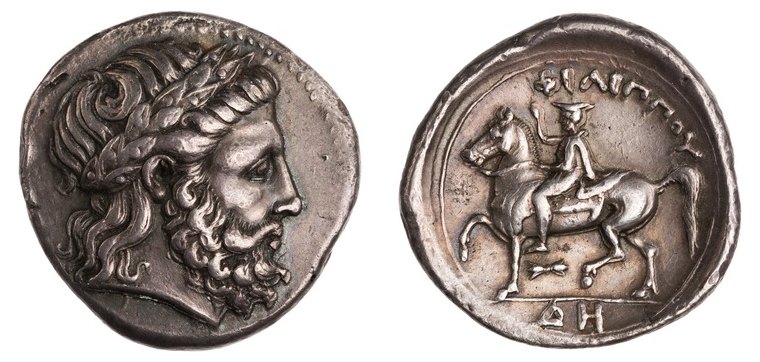
Image source & licence
Coin: American Numismatic Society, 1967.152.197. Public domain.
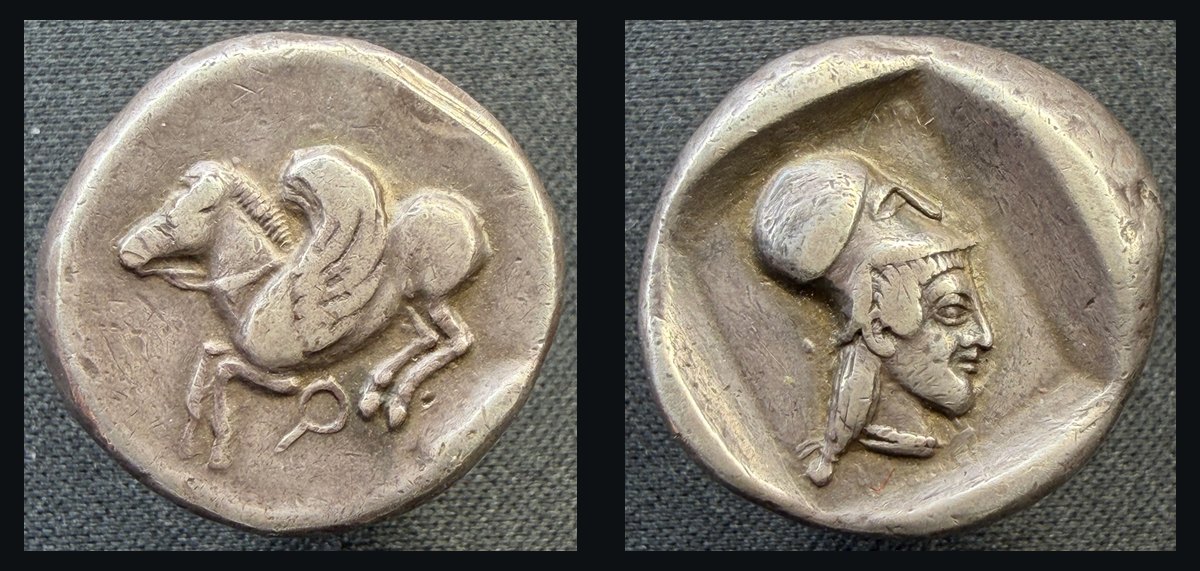
One more coin from the world before Alexander belongs here, because it explains the design of his gold. Corinth had struck a silver stater with Pegasos on one face and Athena in a Corinthian helmet on the other since the sixth century. It was the principal currency of the Greek west. When Alexander came to design his own gold stater in the mid-330s, as hegemon of the League of Corinth which Philip had founded to lead the Greeks against Persia, he chose that same helmeted Athena — a Panhellenic goddess for a Panhellenic crusade.
Thirteen years: the reign at a glance
Philip was murdered at his daughter's wedding in the autumn of 336 BC by one of his own bodyguards. Alexander, twenty, was acclaimed king by the army within hours. He spent his first year securing the northern frontier and then, when Thebes rose in revolt on a rumour of his death, marched 250 miles in thirteen days, stormed the city and razed it to the ground, sparing only the temples and the house of the poet Pindar. Greece did not rise again while he lived. In spring 334 he crossed to Asia.
Upper axis: Macedon from Alexander's birth to the last battle of the Successors. Lower axis: the reign expanded. Dates follow Bosworth 1988 and the standard chronology; Granicus and Hydaspes are dated by month in the sources (Arrian gives Daisios for both), Gaugamela to the day by a Babylonian astronomical diary, and the death to 10/11 June 323 by the same source.
The four battles
Alexander fought four pitched battles in eleven years, and won all four with essentially the same instrument: a disciplined infantry phalanx that fixed the enemy line, and a decisive charge by the Companion cavalry, led in person, at the point where the enemy line could be broken. The two great sieges — Tyre and Gaza — are in the timeline above. What follows is the four battles in turn, each with the maps drawn by the Department of History at West Point, where they are still taught.
Granicus, May 334 BC
The Persian satraps of Asia Minor had an army roughly the size of Alexander's — perhaps 20,000 cavalry and 20,000 Greek mercenary infantry — and a debate about how to use it. Memnon of Rhodes, the Greek commander in Persian service and the most capable man on either side that year, argued for scorched earth: retreat, burn the crops, starve the invader, and take the war to Greece by sea. The satraps, whose estates would have been the ones burned, overruled him and chose to fight at the river Granicus, near Troy.
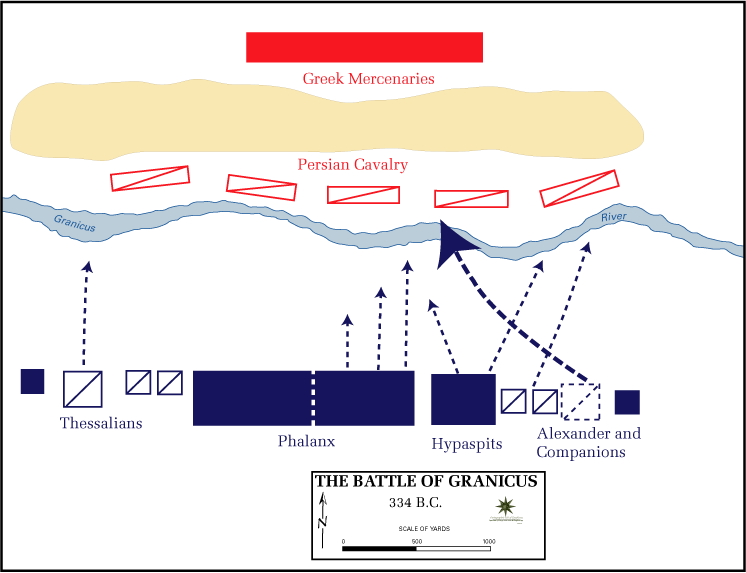
Image source & licence
Map: Dept. of History, United States Military Academy (cartographer Frank Martini). Public domain (work of the U.S. Federal Government).
They deployed badly, putting their cavalry along the river bank in front and their infantry behind, which meant the cavalry could not charge and the infantry could not fight. Parmenion, Philip's old general, advised waiting until dawn; Alexander, according to Arrian, said he would be ashamed to have crossed the Hellespont and then be stopped by a stream, and attacked in the late afternoon. He sent a first wave obliquely across on the right to draw the Persian cavalry down, then led the Companions across the river and up the bank into the resulting confusion. The fight at the top of the bank was a cavalry mêlée at close quarters: Alexander's lance broke, a Persian noble's scimitar split his helmet, and Cleitus the Black cut off the arm of a second man in the act of striking the king from behind. When the Persian cavalry broke, the Greek mercenaries, who had not struck a blow, were surrounded and slaughtered; the two thousand survivors were sent to Macedon in chains as traitors to Greece.
Alexander sent three hundred captured Persian panoplies to Athens to be dedicated on the Acropolis, inscribed “Alexander son of Philip and the Greeks, except the Spartans, from the barbarians who dwell in Asia.” The western satrapies fell in a year. Sardes, with its treasury and its mint, surrendered without a fight; Miletus and Halikarnassos were taken by siege, the latter defended by Memnon himself. Memnon died of illness in 333, and with him the Persian navy's chance of taking the war to Greece.
Issus, November 333 BC
The second battle was against the Great King himself. Darius III brought the royal army west — the Greek sources give absurd numbers, 600,000 in Arrian; modern estimates run to perhaps 60,000–100,000 — and did something Alexander did not expect. While Alexander marched south along the Syrian coast, Darius came through the Amanic Gates behind him and cut his line of communications, taking the Macedonian hospital at Issus and mutilating the sick. Alexander had to turn round and march back north to fight a battle facing the wrong way.
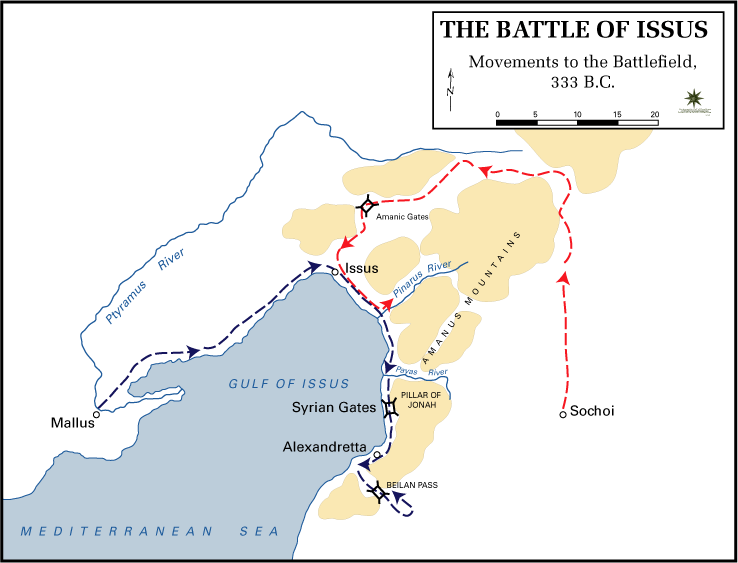
Image source & licence
Map: Dept. of History, United States Military Academy (cartographer Frank Martini). Public domain (work of the U.S. Federal Government).
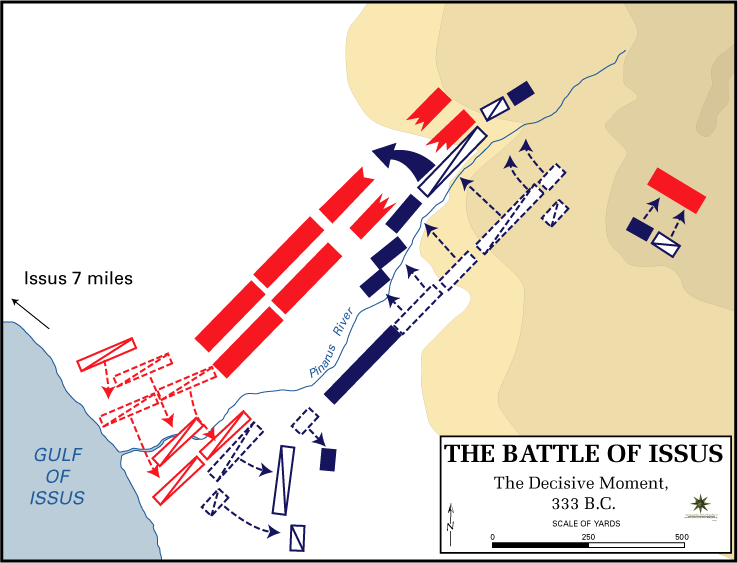
Image source & licence
Map: Dept. of History, United States Military Academy (cartographer Frank Martini). Public domain (work of the U.S. Federal Government).
The ground saved him. The plain between the mountains and the sea at the river Pinarus was only a couple of miles wide, so Darius's numbers could not be brought to bear. Darius put his Greek mercenaries in the centre, his heavy cavalry on the right by the sea, and lighter troops on the left against the hills. Alexander, once again on his own right, charged across the river at the Persian left, which gave way at once; the phalanx in the centre, struggling across the river bank, was badly cut up by the Greek mercenaries and lost a hundred and twenty officers. Alexander then did the thing the Alexander Mosaic shows: he turned the Companions inward and drove for Darius's chariot. Darius fled — abandoning his chariot, his bow, his shield, his cloak, and, in the camp, his mother, his wife, and his children, whom Alexander treated with elaborate courtesy for the rest of their lives.
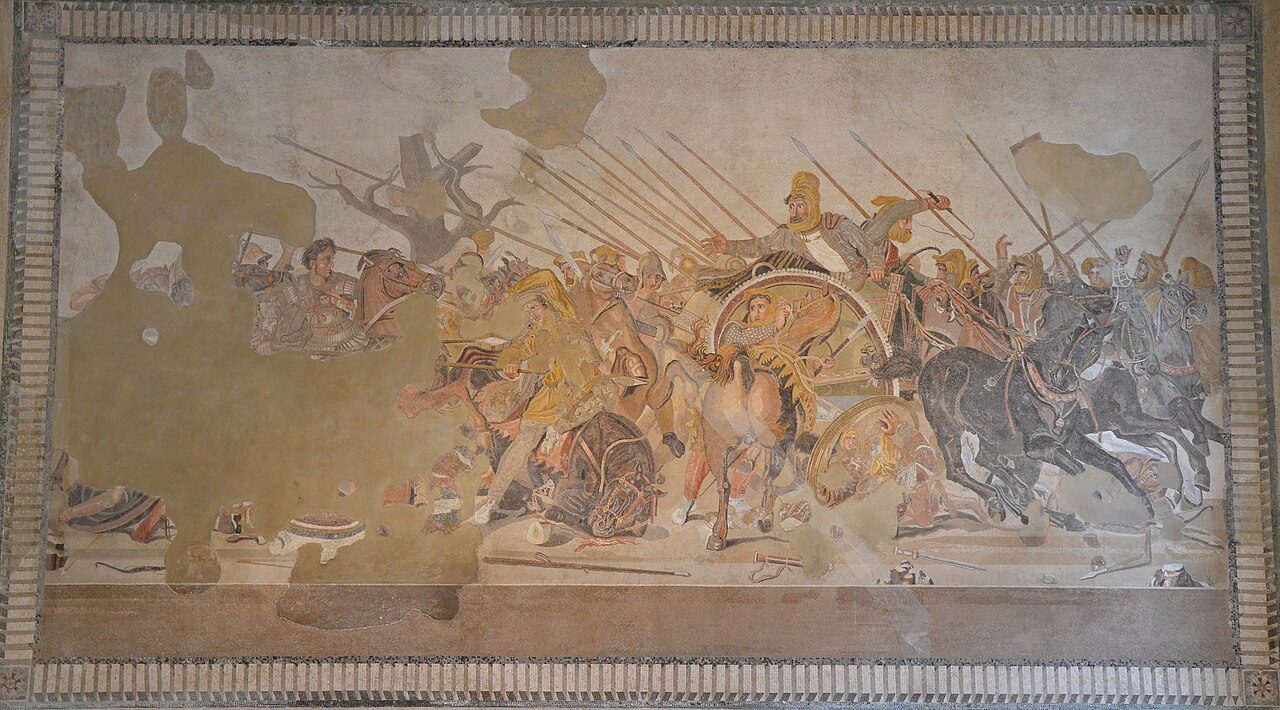
Image source & licence
Photo: Carole Raddato, via Wikimedia Commons. CC BY-SA 2.0.
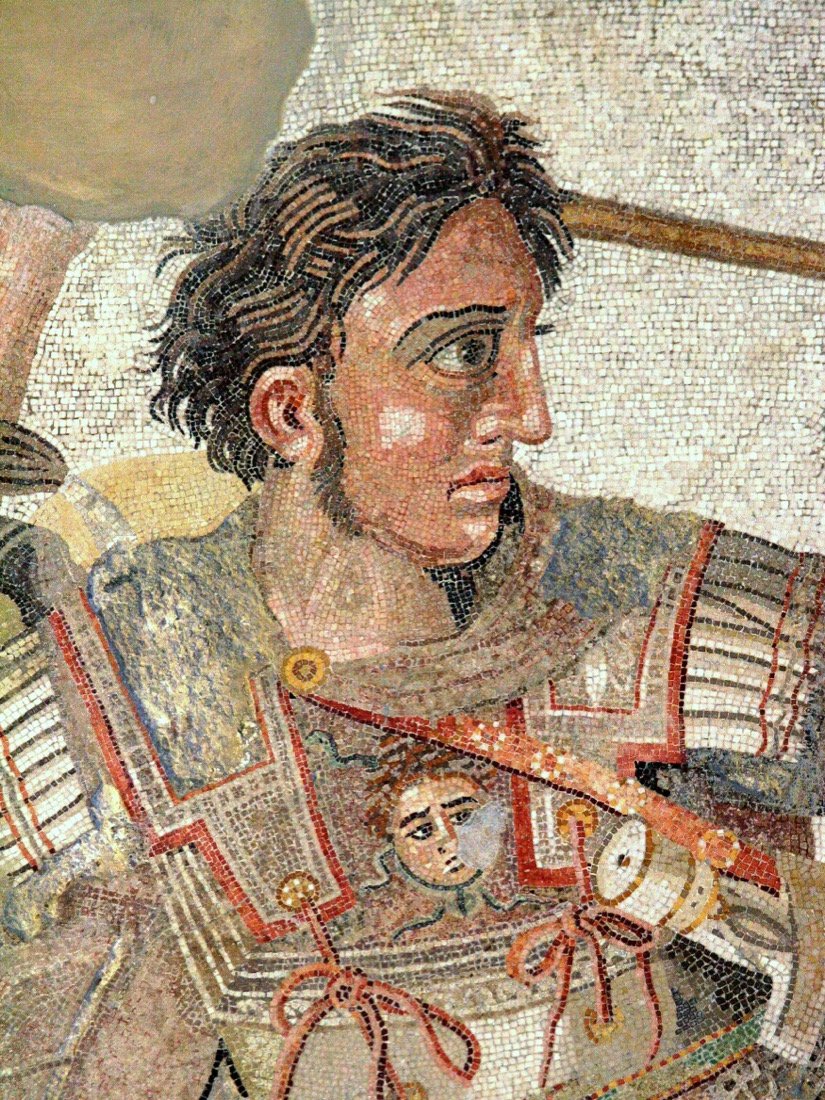
Image source & licence
Photo: detail of the Alexander Mosaic, via Wikimedia Commons; public domain (faithful reproduction of a work in the public domain).
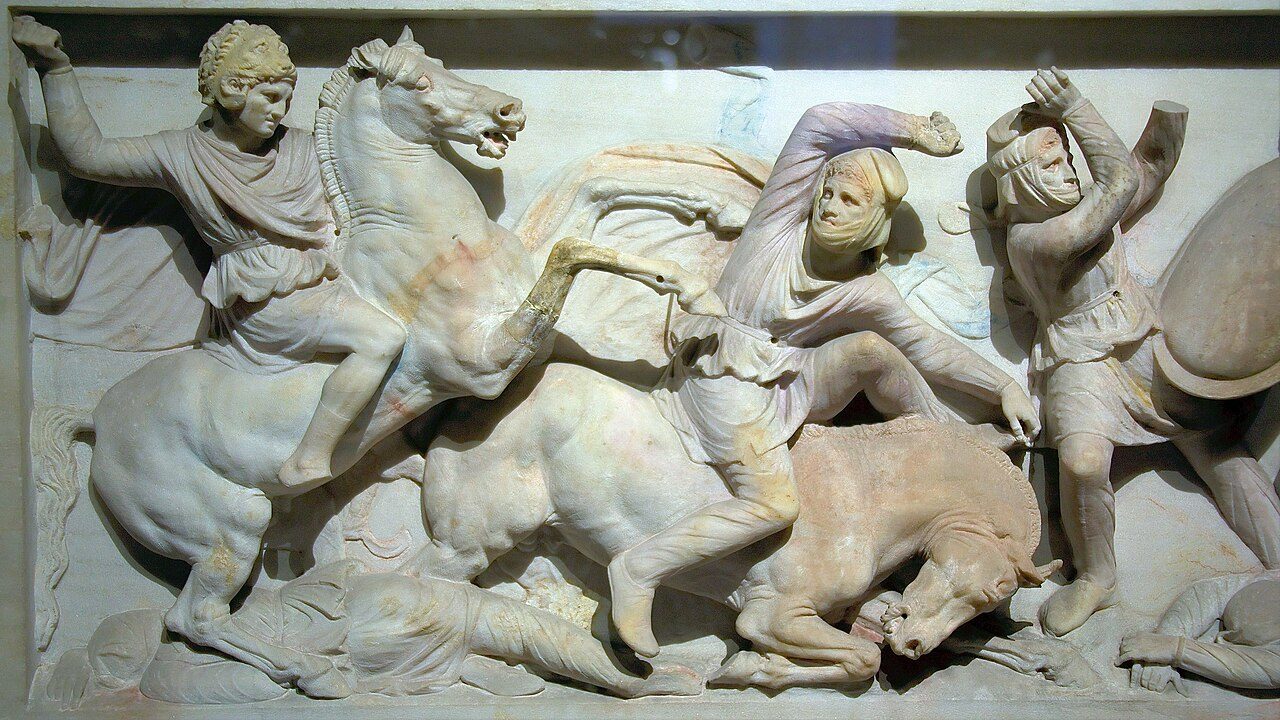
Image source & licence
Photo: Ronald Slabke, via Wikimedia Commons. CC BY-SA 3.0.
Darius offered peace: everything west of the Euphrates, 10,000 talents, and his daughter in marriage. Parmenion is supposed to have said he would accept if he were Alexander; Alexander replied that so would he, if he were Parmenion. Instead he turned south to take the Persian fleet's bases from the land. Tyre, on an island half a mile offshore, refused him entry; he spent seven months building a causeway out to it (the mole is still there — Tyre has been a peninsula ever since), took it by assault in July 332, and killed or enslaved the population. Gaza held out for two months more and met the same end. Egypt, which hated Persia, surrendered without a blow; Alexander was crowned pharaoh at Memphis, founded Alexandria on the coast in early 331, and made a long detour into the Libyan desert to the oracle of Ammon at Siwa, where the priest greeted him — the sources are unanimous, and coy about the rest — as the son of the god. The ram's horns of Ammon would appear on his coin portrait within a generation of his death.
Gaugamela, 1 October 331 BC
Darius had two years to prepare, and this time he chose the ground. Near Gaugamela, east of the Tigris in what is now northern Iraq, he had a plain levelled so that his two hundred scythed chariots and his fifteen elephants — the first Macedon had ever faced — could run, and he had gathered the whole military manpower of the eastern empire: Bactrians, Sogdians, Scythians, Indians, Persians, Medes. Modern estimates put it at perhaps 100,000; Alexander had about 47,000. The Macedonian officers wanted a night attack. Alexander refused: he would not, he said, steal his victory. He slept so soundly on the morning of the battle that Parmenion had to wake him.
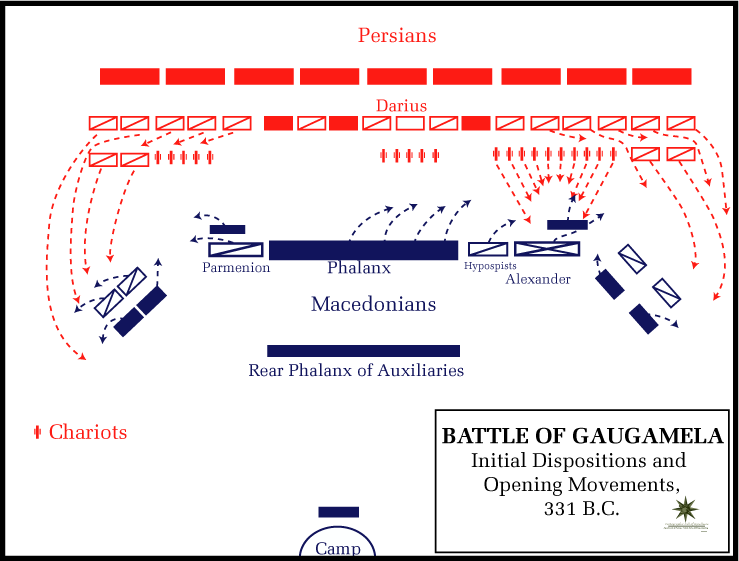
Image source & licence
Map: Dept. of History, United States Military Academy (cartographer Frank Martini). Public domain (work of the U.S. Federal Government).
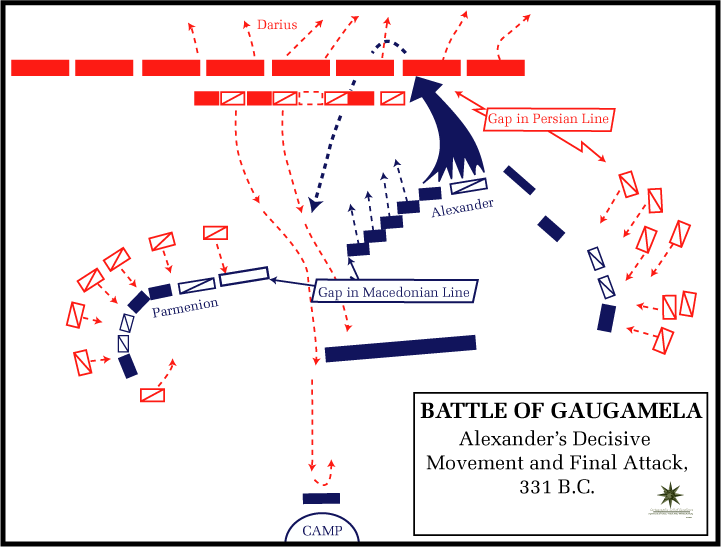
Image source & licence
Map: Dept. of History, United States Military Academy (cartographer Frank Martini). Public domain (work of the U.S. Federal Government).
The battle was won by a manoeuvre. Alexander advanced not straight ahead but obliquely to his right, towards the edge of the prepared ground, so that the Persian left had to shift sideways to keep from being outflanked. Darius launched his chariots early to stop the drift; the Macedonian light infantry shot down the drivers and the phalanx opened lanes to let the rest through harmlessly. As more and more Persian cavalry peeled off leftward to stop the Macedonian right, a gap opened in the Persian line near the centre. Alexander formed the Companions into a wedge and went through it, straight for Darius. For the second time the Great King turned his chariot and fled, and the centre collapsed behind him.
It was nearly lost on the other wing. Parmenion's left, holding back to anchor the oblique advance, was enveloped by the Persian right under Mazaios — the same Mazaios whose Tarsos staters are in this collection — and a body of Indian and Persian horse broke clean through to the Macedonian camp. Alexander, according to Arrian, was called back from the pursuit by a message from Parmenion and fought the bloodiest cavalry action of the day on the way. But the Persian army was gone. Babylon surrendered within weeks (Mazaios, who had commanded its garrison, negotiated the surrender and was made its satrap); Susa yielded 50,000 talents of silver; and in January 330 Alexander took Persepolis, the ceremonial capital, with a treasury Diodorus puts at 120,000 talents — so much bullion that it took 10,000 pairs of mules and 5,000 camels to carry it away.
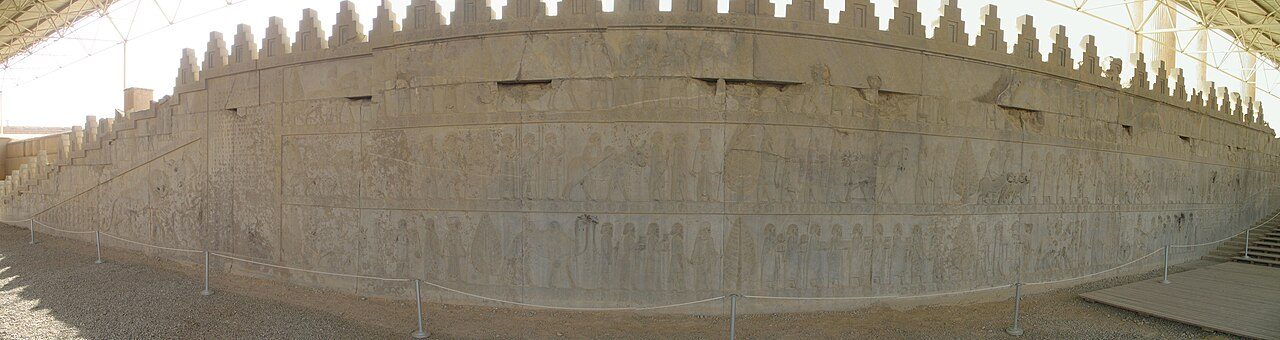
Image source & licence
Photo: Ivan Mlinaric, via Wikimedia Commons. CC BY 2.0.
Darius fled east and was murdered in July 330 by his own satrap of Bactria, Bessus, who proclaimed himself king. Alexander, arriving too late, covered the body with his own cloak and sent it to Persepolis for royal burial. He then hunted Bessus down, had him mutilated in the Persian manner and executed, and spent the next two years — the hardest of the war — in the guerrilla campaigns of Bactria and Sogdiana, where he married the Bactrian princess Roxane and, in a drunken quarrel at Marakanda, killed Cleitus the Black, the man who had saved his life at the Granicus.
Hydaspes, May 326 BC
The last of the four battles was fought in the Punjab against an enemy who was not Persian at all. Porus, king of the Pauravas, held the far bank of the river Hydaspes (the modern Jhelum) with an army built around perhaps a hundred war elephants — against which the Macedonian horses would not charge. It was the beginning of the monsoon; the river was high, fast and half a mile wide.
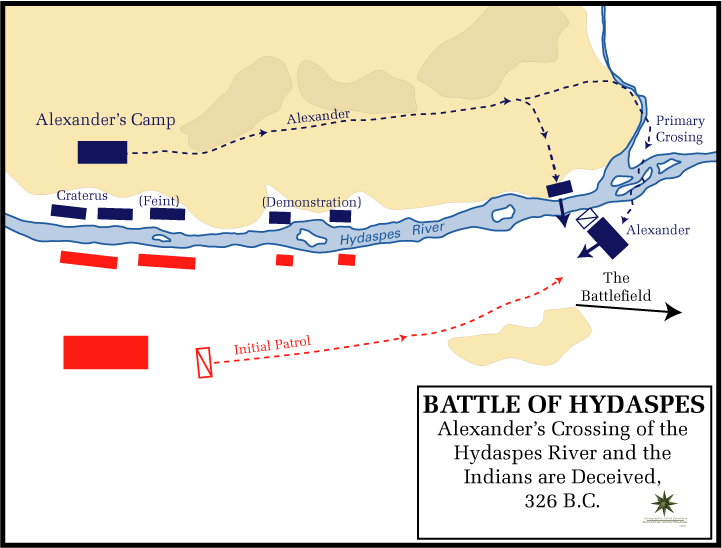
Image source & licence
Map: Dept. of History, United States Military Academy (cartographer Frank Martini). Public domain (work of the U.S. Federal Government).
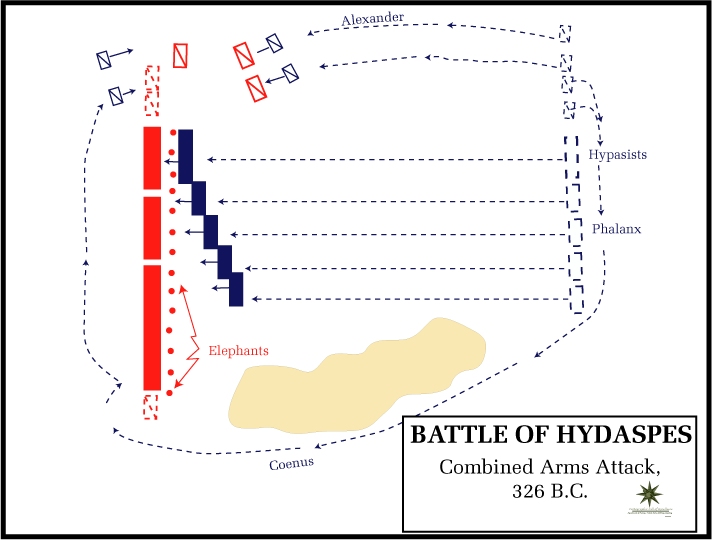
Image source & licence
Map: Dept. of History, United States Military Academy (cartographer Frank Martini). Public domain (work of the U.S. Federal Government).
Alexander solved the river by deception. Night after night he moved troops noisily up and down the bank, until Porus, who had at first shadowed every movement, gave up and stayed in camp. Then, on a night of violent thunderstorm, Alexander took some 11,000 men seventeen miles upstream, crossed at a wooded island that hid the boats, and came down the far bank at dawn while Craterus, with the main camp, kept Porus fixed opposite. Porus turned to meet him with his whole army, elephants in a line in front of the infantry, cavalry on the wings. Alexander refused to send the phalanx at the elephants until he had dealt with the cavalry: he attacked the Indian left with his own horse, sent Coenus round behind it, and when the Indian cavalry was broken the elephants were left to face archers, javelin-men and sarissas from every direction. Maddened, they trampled their own infantry as often as the enemy. Porus, wounded and the last man fighting on his elephant, was brought to Alexander and asked how he wished to be treated. “As a king,” he said — and was, keeping his kingdom and gaining more.
It was the costliest of Alexander's victories — and it killed Bucephalus, the horse he had tamed as a boy and ridden through every battle, who died of wounds or age soon after. Alexander founded a city on the site and named it Bucephala. Two months later, at the river Hyphasis, the army refused to go further. Alexander sulked in his tent for three days, then gave in, built twelve altars to the gods, and turned south down the Indus. On the way back he nearly died leading an assault on a Mallian town, taking an arrow through the lung; and in the autumn of 325 he led the army through the Gedrosian desert, where more men died of thirst than had died in all four battles together.
He reached Susa in early 324 and held the mass wedding at which he and ninety of his officers married Persian noblewomen. At Opis that summer the Macedonian army mutinied when he announced the discharge of ten thousand veterans; he faced them down, and reconciled with them at a banquet for nine thousand. His closest friend Hephaestion died at Ecbatana that autumn. Alexander himself, after a long drinking party in Babylon, took a fever and died on the evening of 10 or 11 June 323 BC. Asked to whom he left the kingdom, he is supposed to have said: to the strongest.
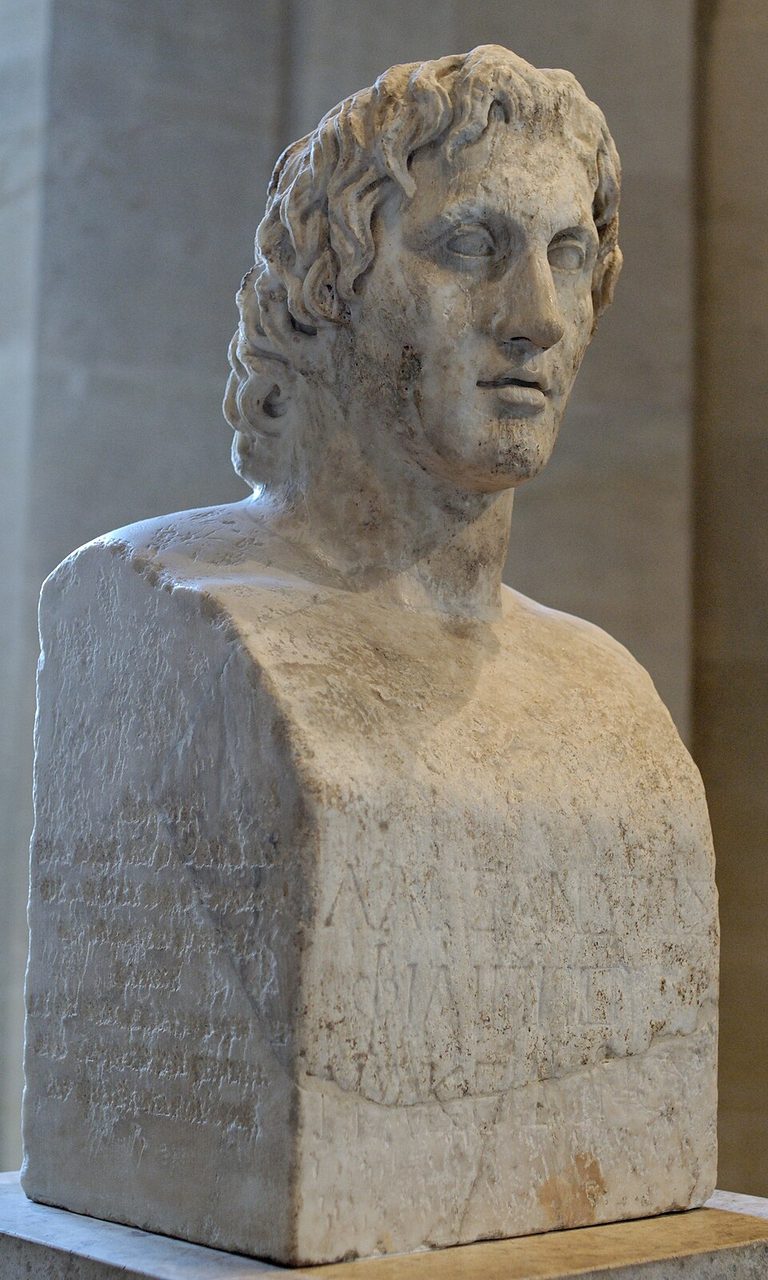
Image source & licence
Photo: Jastrow (Marie-Lan Nguyen), via Wikimedia Commons. Public domain.
The coinage of Alexander
Alexander's coinage is the most studied in the ancient world — Martin Price's 1991 corpus runs to some 4,000 varieties from more than a hundred mints — and yet its two central questions, when the types began and whom the Herakles head portrays, are still argued. What is not in doubt is the design of the system. It had three parts, and they were not introduced together.
The gold: Athena and Nike
The gold came first. Probably in 335 or 334 BC — some scholars say from the accession in 336 — Alexander replaced his father's Apollo-and-chariot staters with a new type: the head of Athena in a crested Corinthian helmet, borrowed from the coinage of Corinth (above), and on the reverse a standing Nike, Victory, holding a wreath and a stylis, the mast-and-yard of a ship's stern. The stylis is usually read as a naval reference, and the whole type as a manifesto for the League of Corinth's war against Persia: Panhellenic goddess, victory to come. Struck on the Attic standard at about 8.6 g, the stater was worth twenty silver drachms; a rare double, the distater, was struck as well.
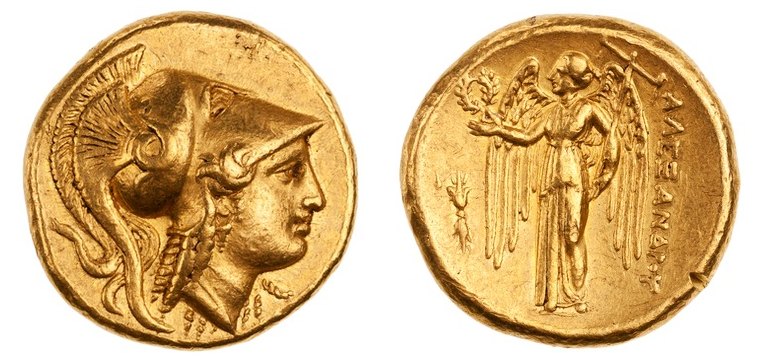
Image source & licence
Coin: American Numismatic Society, 1944.100.319. Public domain.
The silver: Herakles and Zeus
The silver came later, and the best current view — argued by Hyla Troxell from the Macedonian die-studies and by Olivier Casabonne from the Cilician evidence — is that it began not in Macedon at all but at Tarsos, in the winter after Issus, 333/2 BC. Alexander had just taken Mazaios's mint, with its die-cutters and its stock of silver, and needed to pay an army that was now deep in Asia. The reverse type his mint-masters produced was a Greek translation of the coin they had been striking the year before: Mazaios's enthroned Baal of Tarsos became an enthroned Zeus, holding an eagle on his outstretched hand and a sceptre in the other, in exactly the same pose. The obverse was the head of Herakles in the lion-skin — the hero from whom the Macedonian royal house claimed descent, and a type Philip had already used on some of his bronze.
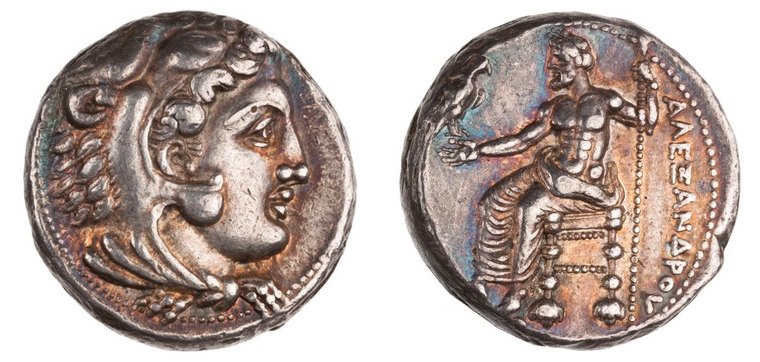
Image source & licence
Coin: American Numismatic Society, 1965.77.80. Public domain.
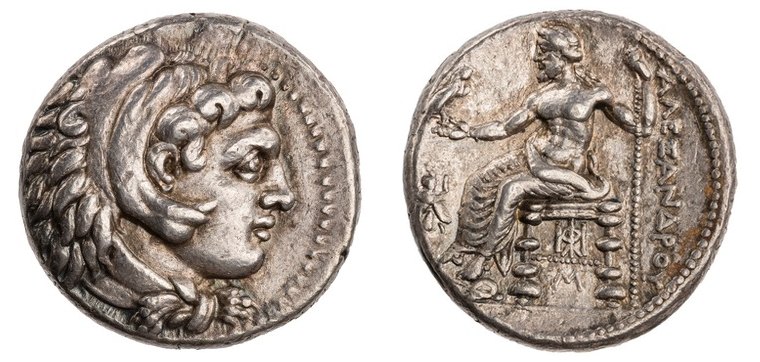
Image source & licence
Coin: American Numismatic Society, 1944.100.80183. Public domain.
The tetradrachm was struck on the Attic standard, about 17.2 g when fresh — the standard of the Athenian owl and therefore of international trade — which is the principal reason it displaced every other silver in the eastern Mediterranean within a generation. The legend was simply ΑΛΕΞΑΝΔΡΟΥ, “of Alexander”, in the genitive: the coin of Alexander, not a coin showing Alexander. Whether the Herakles head was nonetheless meant to suggest the king's own features is the oldest open question in the series (see the endnote). The lion-skin helmet he wears on the Sidon sarcophagus suggests that his contemporaries, at least, saw the resemblance.
4 drachms. The workhorse: on the usual estimate of a drachm a day, a phalangite’s month came to seven or eight of them.
Same types, small module. Struck mainly in western Asia Minor from c. 325 for local circulation.
Athena / Nike. Worth 20 drachms (5 tetradrachms) at the 10:1 gold–silver ratio.
Herakles / club and bow-in-case, or quiver. Small change for camps and cities; struck in Macedon and across Asia.
The accounting unit: 1,500 tetradrachms, about 26 kg of silver. The treasuries were counted in talents.
Reading an Alexander
Because more than a hundred mints struck the same two types for more than a century, the small marks in the reverse field — a wreath, a torch, a bee, a monogram, a letter — are what tell you where and roughly when a given coin was made. These controls identified the official responsible for an issue, and Price's corpus arranges the whole coinage by them. Two other diagnostics are worth knowing. On the earliest issues Zeus sits with his legs parallel, feet together, like Baaltars; from about 325 the engravers began to cross his legs, right over left, a more relaxed pose that became universal after Alexander's death — a useful but not infallible rule, since it was adopted at different times at different mints. And the legend: coins with ΒΑΣΙΛΕΩΣ, “of the king”, added to Alexander's name were struck only from the last years of the reign at eastern mints, and became common posthumously.
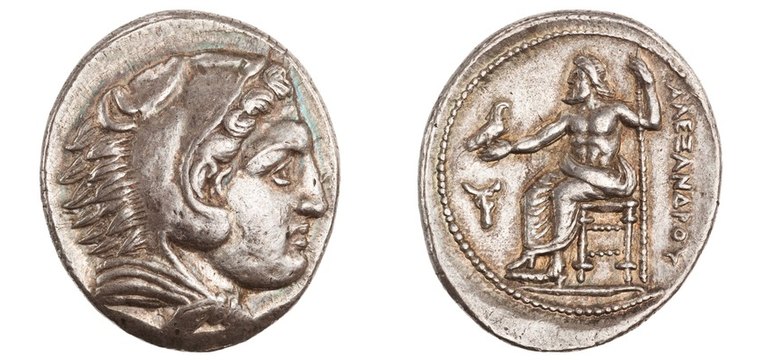
Image source & licence
Coin: American Numismatic Society, 1947.98.38. Public domain.
Price's corpus as a picture. Each row is a mint, opening from the top in the order the mints started; the shading in each year shows how many of Price's catalogue numbers were in issue then (each row on its own scale, so a small mint's busy years still show), and the figure at the right is the mint's total. The bar chart across the top sums every mint: the surge of the last years of the reign, the Successors' output to about 290, the long civic afterlife of the type in Thrace and western Asia Minor in the third and second centuries. Alexander numbers only, all metals; Price's queried attributions are counted with the mint and marked (?) where they are the majority, the numbers he could place only in a region (“Macedonia, uncertain mint”, the great lifetime block Price 163–420) have a row of their own, and the 400 he could place nowhere are omitted. Data: M. J. Price, The Coinage in the Name of Alexander the Great and Philip Arrhidaeus (1991), via the American Numismatic Society's PELLA (ODbL); drawn by img/gen_mint_timeline.py.
The scale of it
The numbers are hard to take in. Strabo says the Persian treasuries yielded 180,000 talents; Justin says 50,000 were still on hand when Alexander died. The difference — something over 100,000 talents, or roughly 3,000 tonnes of silver-equivalent — is what the army, the fleet, the new cities, the satrapal administration and the king's gifts consumed in eight years, and a great deal of it went out as coin. A single episode gives the flavour. At Opis in 324, Alexander discharged 10,000 veterans with a bonus of a talent each on top of their back pay, and paid the debts of the whole army, which Arrian puts at 20,000 talents. Hyla Troxell's die-study found about 330 obverse tetradrachm dies in use at Amphipolis alone in 324–323; at the conventional estimate of 20,000 coins per die, that is some six and a half million tetradrachms from one mint in two years, plus gold. François de Callataÿ has estimated the total output of Alexander-type coinage between 333 and 290 BC at around 60 million tetradrachms, 66 million drachms and 12 million gold staters — some 91,000 talents, or the cost of building the Parthenon about 180 times over.
The drachms deserve a word of their own. They were struck almost entirely in western Asia Minor — Sardes, Miletus, Kolophon, Lampsakos, Abydos, Magnesia — from about 325 BC onward, and stayed there: of the drachms in the great Sinanpaşa hoard from Phrygia, 96 per cent came from those mints. The tetradrachms travelled; the drachms paid the garrisons and markets of the province where they were made. Which is why a Sardes drachm, like the one in this collection, is the cheapest way to hold a coin that may well have been struck in Alexander's lifetime.
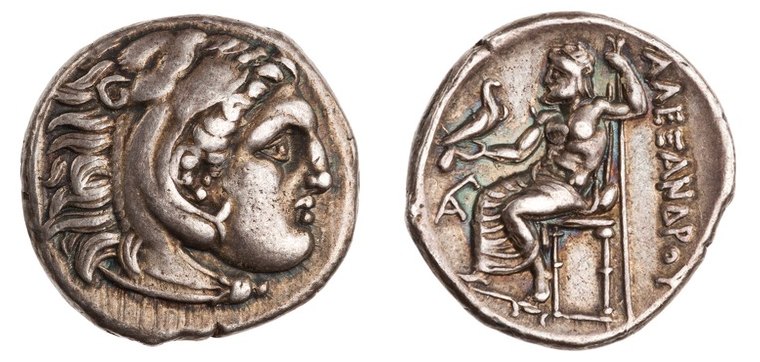
Image source & licence
Coin: American Numismatic Society, 1944.100.29876. Public domain.
The one coin that shows him: the Porus decadrachm
There is exactly one coinage of Alexander's lifetime that depicts him, and it is a strange one. A small group of silver decadrachms — about a dozen are known, most from a single hoard found in Iraq in 1973 — show on one side a horseman with a lance attacking two men on a retreating elephant, and on the other a figure in Macedonian dress and Persian headgear holding a thunderbolt, crowned by a flying Nike. The horseman is Alexander and the elephant carries Porus; the standing figure is Alexander again, with the attribute of Zeus in his hand. Nothing else in Greek art of the period shows a living man wielding the thunderbolt. Related pieces show elephants, archers and chariots. They were struck, most scholars think, at Babylon or Susa around 325–323 BC — Frank Holt argues, as commemorative medals for the veterans of India; others read them as a Persian-style victory issue — and they are the nearest thing to a portrait Alexander ever put on metal.
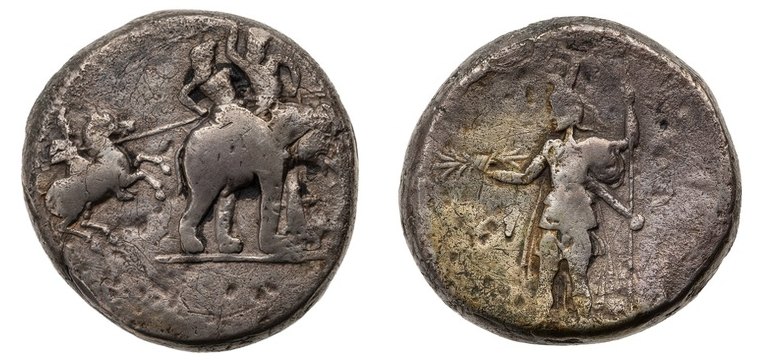
Image source & licence
Coin: American Numismatic Society, 1959.254.86. Public domain.
In this collection
Four coins in Alexander's name, spanning the reign and the decade after it. Each links to its own type page.
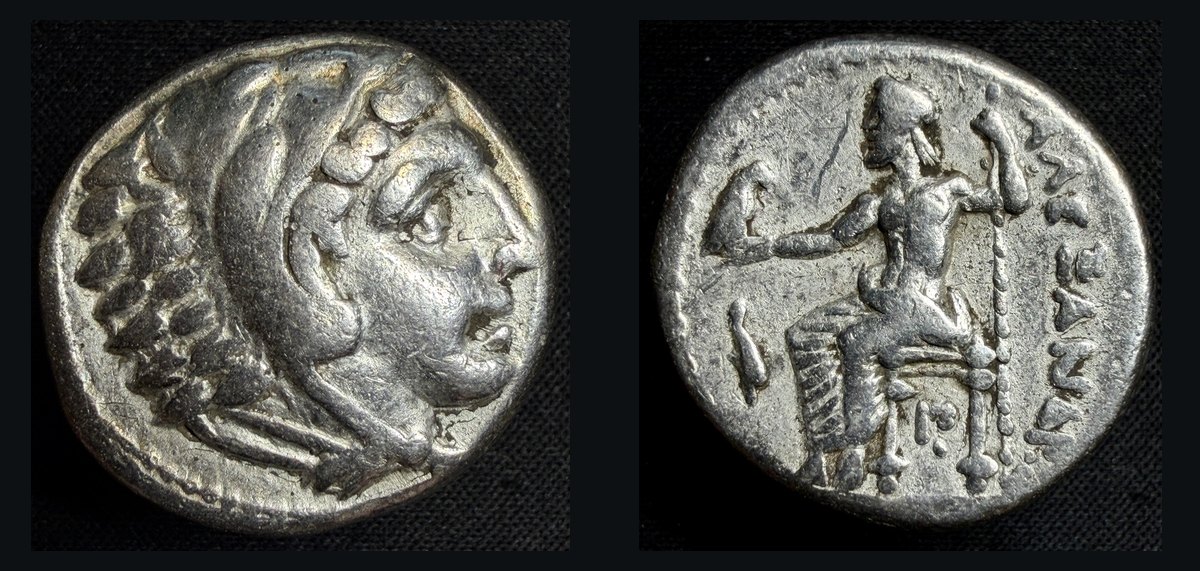
Struck at the home mint under the regents Antipater or Polyperchon in the reign of Philip III, a few years after Alexander’s death. Zeus still sits with legs parallel, the old way; the aplustre — a ship's stern ornament — in the left field and the ΠΟ monogram below the throne are the controls that place it. The finest of the four.
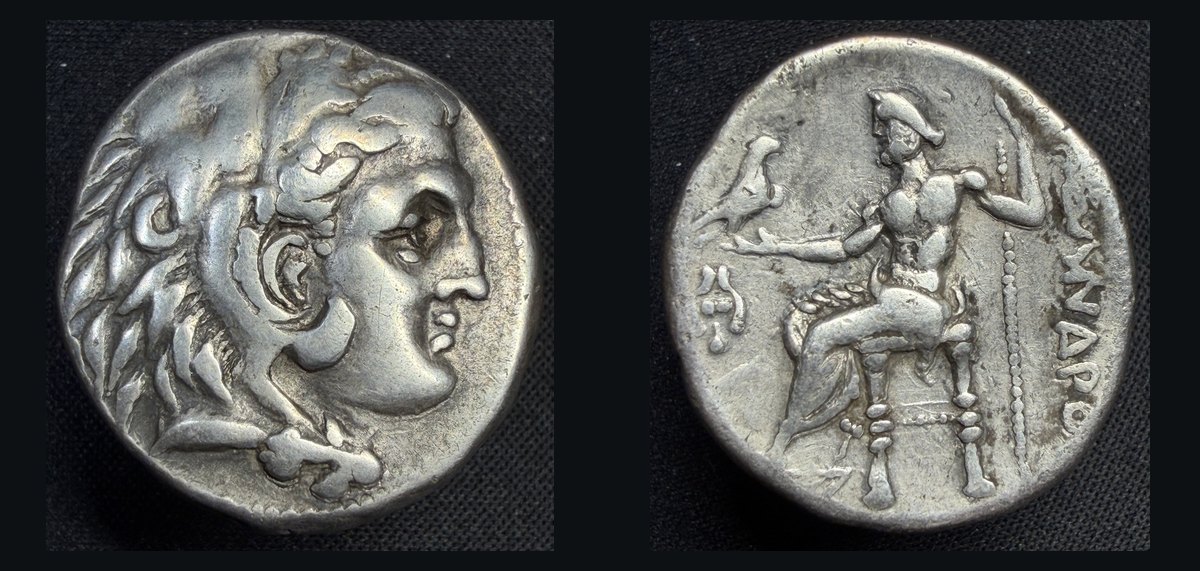
From the Ionian city that became one of the busiest Alexander mints in western Asia Minor. Kolophon began striking in the king's name around 325; this coin belongs to the first years of the mint, and its exact position in the sequence — lifetime or immediately posthumous — turns on a control mark still being pinned down. The Herakles head at the top of this page is its obverse.
Sear 6717 var.; Price number under review
→ Type page
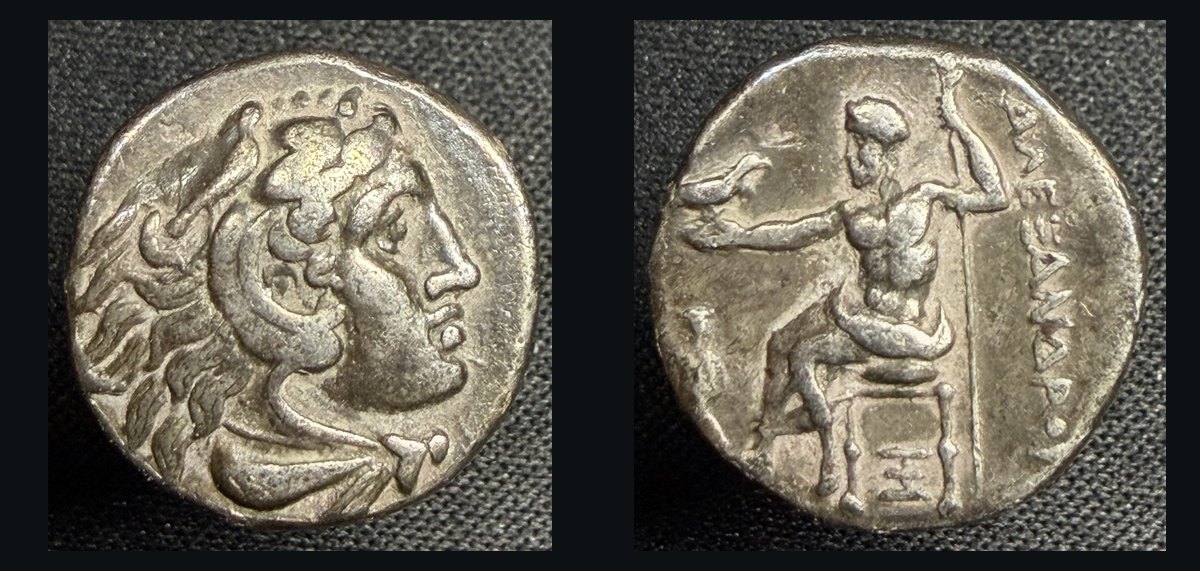
The small silver of the western drachm belt, from the mint that had struck the Great King's sigloi for two centuries and surrendered to Alexander in the summer of 334. Same types as the tetradrachm at a quarter of the weight.
Price / Thompson ADM I, Sardes series; control match pending
→ Type page
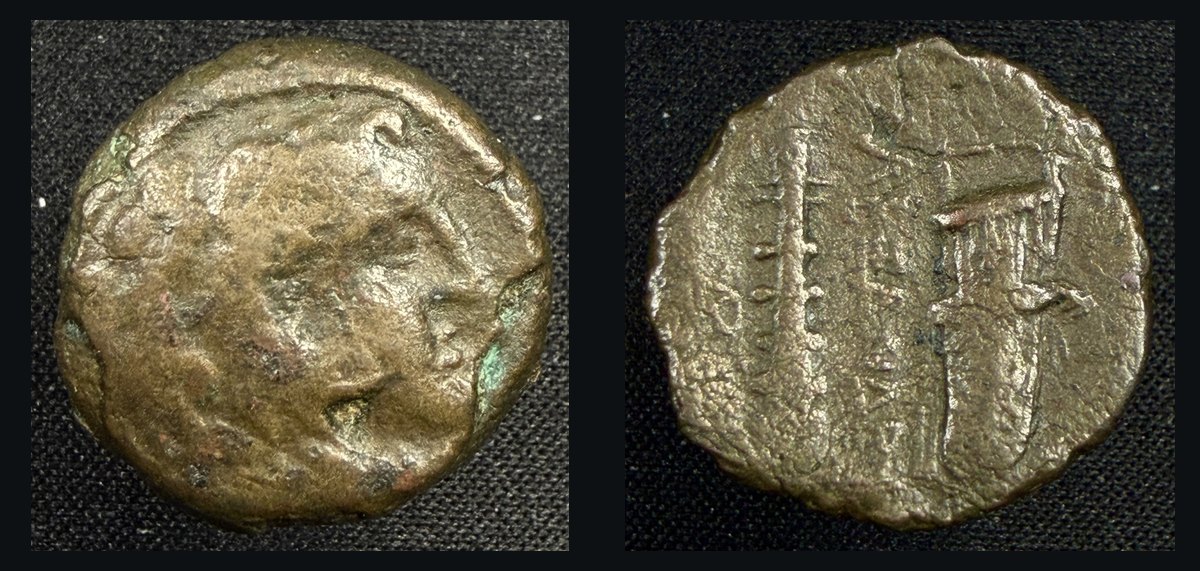
Herakles in the lion-skin / club above bow in its case, ΑΛΕΞΑΝΔΡΟΥ between, ΑΡ monogram below. The everyday coin of Alexander's Macedon — the one denomination in the collection that is securely of the reign itself.
SNG Copenhagen 1055 type
→ Type page
What the collection does not yet hold is a tetradrachm certainly struck while Alexander was alive. The Amphipolis coin is a few years too late; the Kolophon coin sits on the boundary. The gap is deliberate rather than accidental — the right coin, from one of the eastern mints that Alexander himself set going, is the next acquisition in this series, and this section is written so that it can drop in here when it arrives. Meanwhile, the specimen below shows what it should look like.
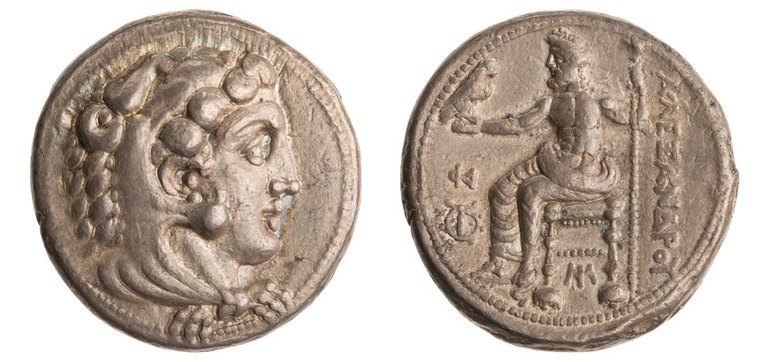
Image source & licence
Coin: American Numismatic Society, 1944.100.34250, via PELLA, Price 3230. Public domain.
The world he left
Alexander left no adult heir: a half-brother, Philip III Arrhidaios, who was mentally incapable, and a son, Alexander IV, born to Roxane two months after his death. The generals proclaimed both as joint kings at the Partition of Babylon, divided the satrapies among themselves, and then spent forty years fighting the Wars of the Successors over the pieces. Philip III was murdered in 317, Alexander IV about 310; from 306 the survivors began calling themselves kings. The coinage tracks every stage of it.
Coins in the name of the dead king
For the first twenty years almost nobody changed the money. Mints across the empire went on striking Herakles and Zeus with ΑΛΕΞΑΝΔΡΟΥ — the Amphipolis and Kolophon tetradrachms above are of this kind — and some struck the identical types with ΦΙΛΙΠΠΟΥ for the puppet Philip III. Alexander's name was the only thing all the generals could agree on, and the soldiers trusted it. That is why the “posthumous Alexander” is by far the commonest Greek silver coin: the empire's mints kept producing it as a matter of course, and the cities of Asia Minor were still striking civic Alexanders, with their own badges in the field, into the first century BC.
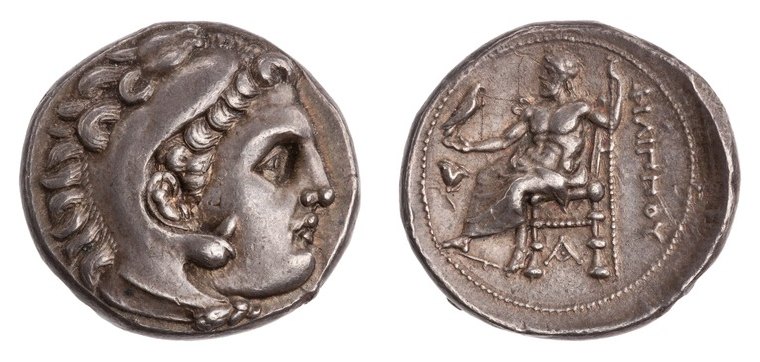
Image source & licence
Coin: American Numismatic Society, 1944.100.31284. Public domain.
Ptolemy: the first portrait of Alexander, and the first portrait of himself
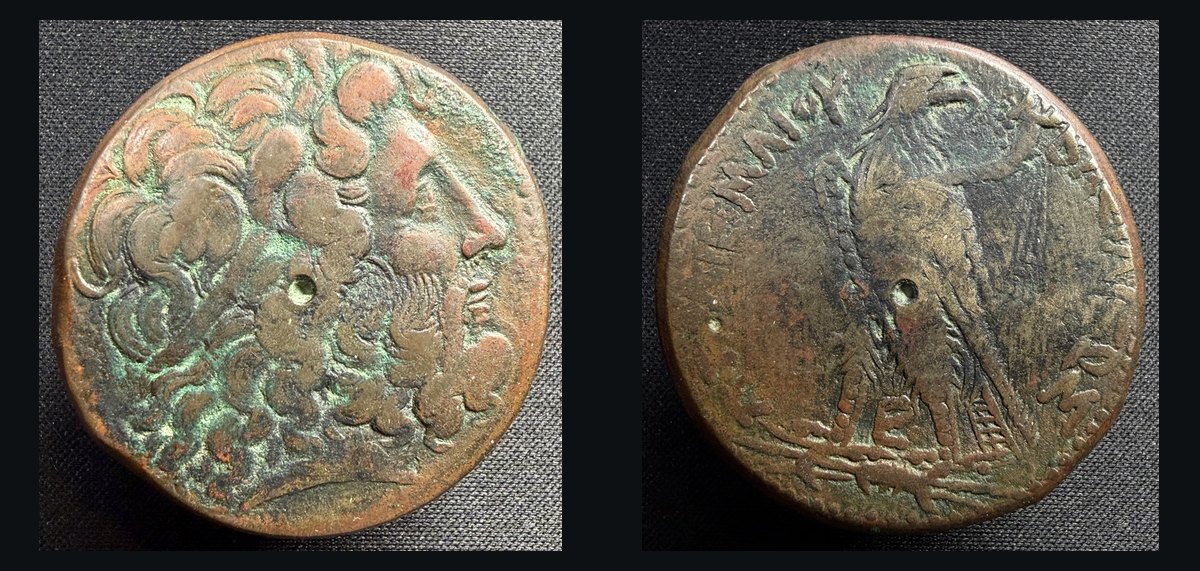
The man who broke ranks first was Ptolemy, who had taken Egypt at the Partition — and taken Alexander's body too, hijacking the funeral cortege on its way to Macedon and installing it at Memphis and then Alexandria, where it became the dynasty's founding relic. Around 319 BC Ptolemy replaced Herakles on his tetradrachms with a head of Alexander himself, deified: wearing an elephant's scalp for the conquest of India, with the ram's horn of Ammon curling at his temple and the aegis of Zeus knotted at his throat. It is the first coin portrait of Alexander, and the beginning of the whole Hellenistic tradition of royal portraiture. Ptolemy then lowered the weight standard step by step, closing Egypt into a currency zone of its own; put his own diademed head on gold in 298/7; and by 294 had settled on the tetradrachm type his dynasty would strike for the next 260 years: Ptolemy's portrait, and an eagle on a thunderbolt.
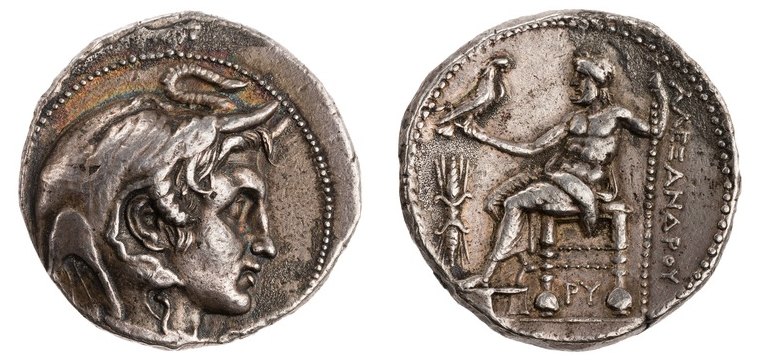
Image source & licence
Coin: American Numismatic Society, 1957.172.1269. Public domain.
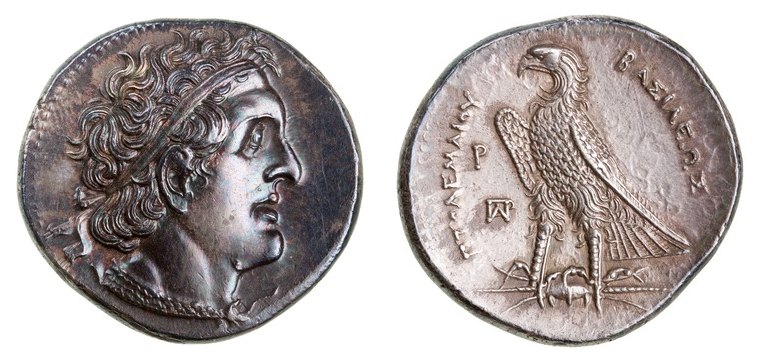
Image source & licence
Coin: American Numismatic Society, 1944.100.73309. Public domain.
Lysimachos: the horned king
Lysimachos, one of Alexander's bodyguards, took Thrace at the Partition and, after Ipsus in 301, most of Asia Minor as well. In 297/6 he introduced the most beautiful of all the successor coinages: the head of the deified Alexander, diademed, with the ram's horn of Zeus Ammon springing from his temple, and on the reverse Athena enthroned holding a small Nike who crowns the name of Lysimachos. It made explicit what Ptolemy had implied — Alexander as a god, and the new king as his heir — and it was so admired that cities on the Black Sea went on striking it for two centuries. Lysimachos himself died in battle at Korupedion in 281, the last of the Successors to fall in the field, aged about eighty.
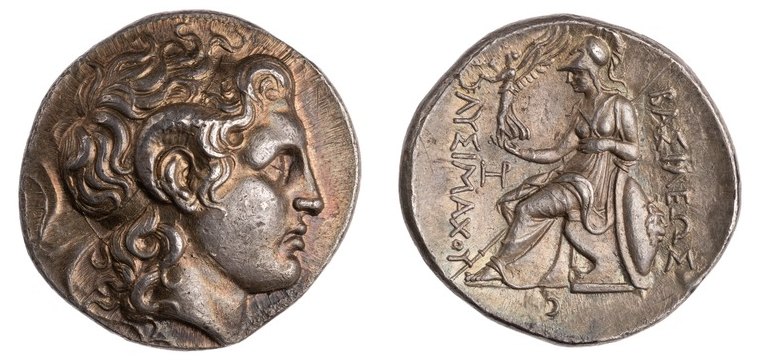
Image source & licence
Coin: American Numismatic Society, 1997.9.70. Public domain.
Seleukos: the largest share
Seleukos, commander of the elite infantry in India, got Babylon in 321, lost it, and took it back in 312 — the year from which his dynasty counted its era. By 305 he had recovered everything east to the Indus, and in 303 he traded the Indian provinces to Chandragupta Maurya for five hundred war elephants, which won Ipsus two years later. His coinage began as Alexanders, in Alexander's name and then his own; after Ipsus his mint at Susa struck an extraordinary tetradrachm showing a helmeted head in a panther-skin — probably Seleukos himself, in the guise of a hero, though some have seen Alexander — and on the reverse Nike crowning a trophy of Macedonian arms. His son Antiochos I settled the dynasty's type for good: Apollo, the family's claimed ancestor, seated on the omphalos of Delphi.
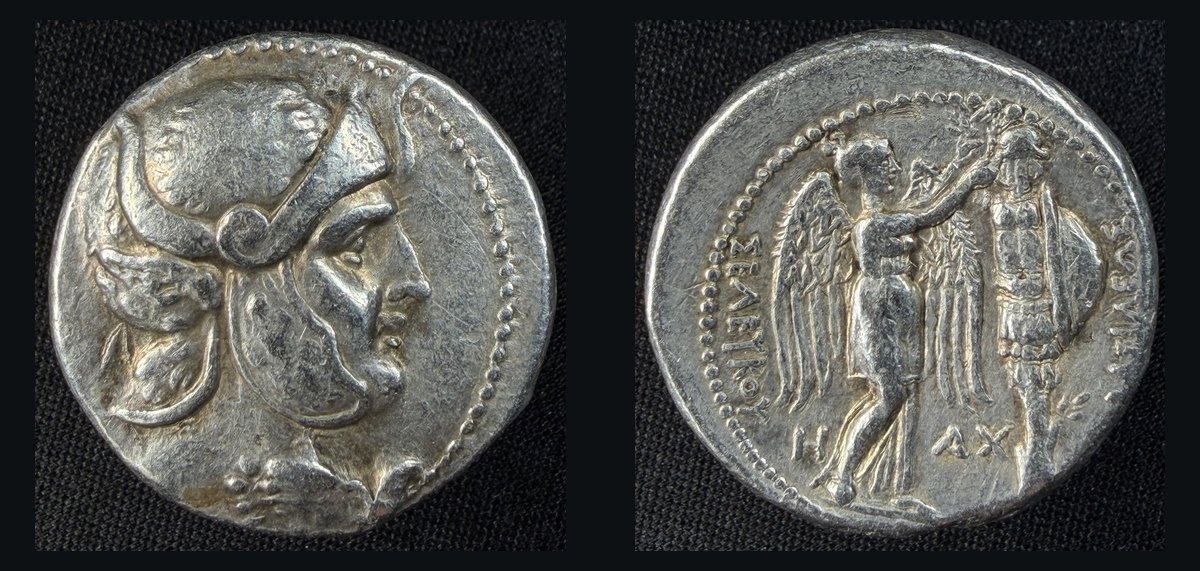
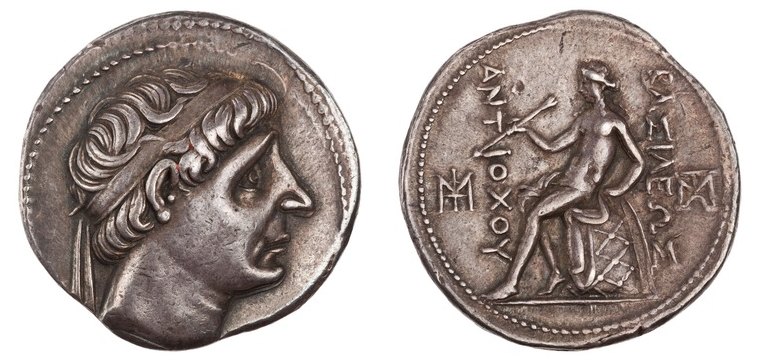
Image source & licence
Coin: American Numismatic Society, 1946.89.93. Public domain.
Demetrios and Rhodes: the siege that built a wonder
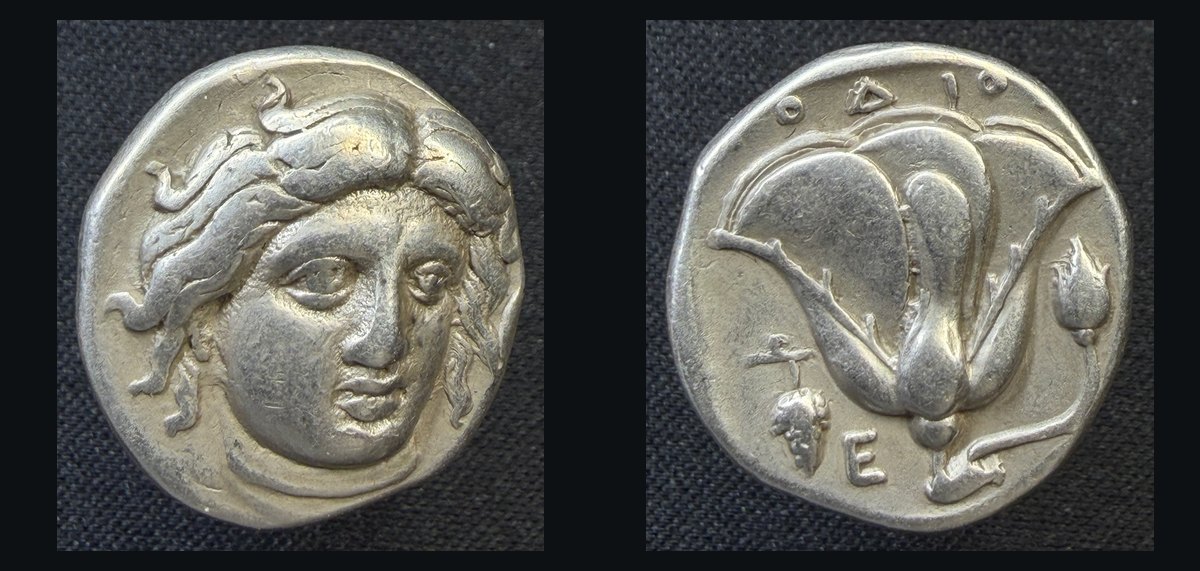
Antigonos the One-Eyed, Alexander's satrap of Phrygia, came closest of all the Successors to reuniting the empire, and his son Demetrios Poliorketes — “the Besieger” — was the age's most brilliant and least reliable soldier. In 305–304 Demetrios besieged Rhodes for a year with the largest siege engines yet built, including a nine-storey armoured tower, the Helepolis; the Rhodians held out, and when he withdrew they sold the abandoned machinery and used the proceeds to erect the Colossus — a 33-metre bronze Helios, one of the Seven Wonders — at the harbour. Antigonos died at Ipsus in 301, aged eighty-one; Demetrios put his own portrait on his coins with a bull's horn, the badge of Poseidon, whose favourite he claimed to be, and ended his life a prisoner of Seleukos.
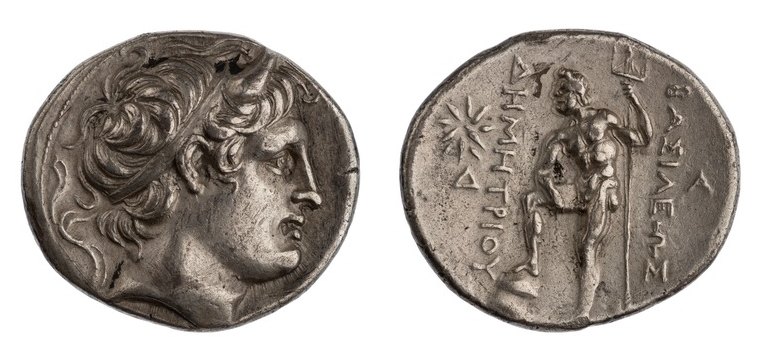
Image source & licence
Coin: American Numismatic Society, 1967.152.208. Public domain.
Coda: the last of the line
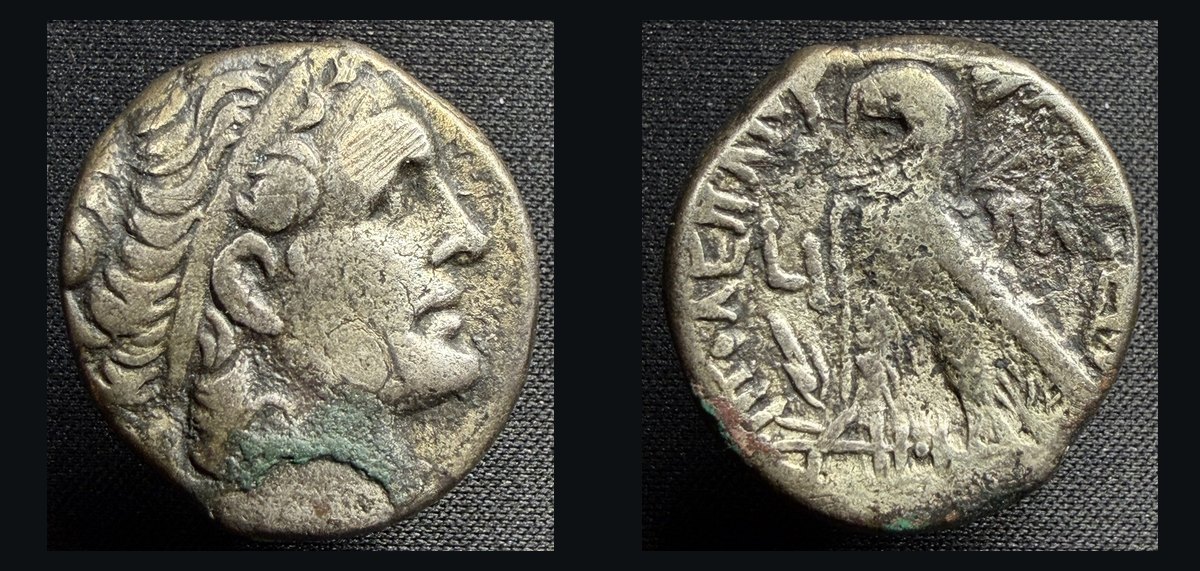
The Ptolemies outlasted every other successor dynasty, and the last of them, Cleopatra VII, was still striking the eagle-and-thunderbolt tetradrachm of Ptolemy I — with his portrait, not hers — in the 40s BC, when she was Caesar's ally and then Antony's. The type had been current for 250 years. When she died in 30 BC, the last kingdom founded by one of Alexander's generals passed to Rome, and Alexander's own tomb, which Augustus visited that year, was the last stop on the tour.
At a glance
| Coin | Who & when | Types | Reference | |
|---|---|---|---|---|
| AR siglos (held) | Lydia, Persian period, c. 550–520 BC | Lion & bull / incuse | as SNG Kayhan 1018 |
| AR siglos (held) | Achaemenid Sardes, c. 505–480 BC | Great King archer / incuse | Carradice Type II |
| AR stater (held) | Corinth, c. 490–450 BC | Pegasos / Athena | Ravel Period II; Pegasi 68 |
| AR tetradrachm (held) | Athens, c. 454–404 BC | Athena / owl | Kroll 8; HGC 4, 1597 |
| AR tetradrachm (held) | Egypt, c. 450–330 BC | Imitation owl | Van Alfen III.A.1; Buttrey X |
| AR stater (held) | Mazaios, Tarsos, 361–334 BC | Baaltars / lion & bull | SNG Levante 106; Casabonne Ser. 2 |
| AR tetradrachm (held) | Athens, Pi-style, c. 353–294 BC | Athena / owl | Bingen Pi III; HGC 4, 1599 |
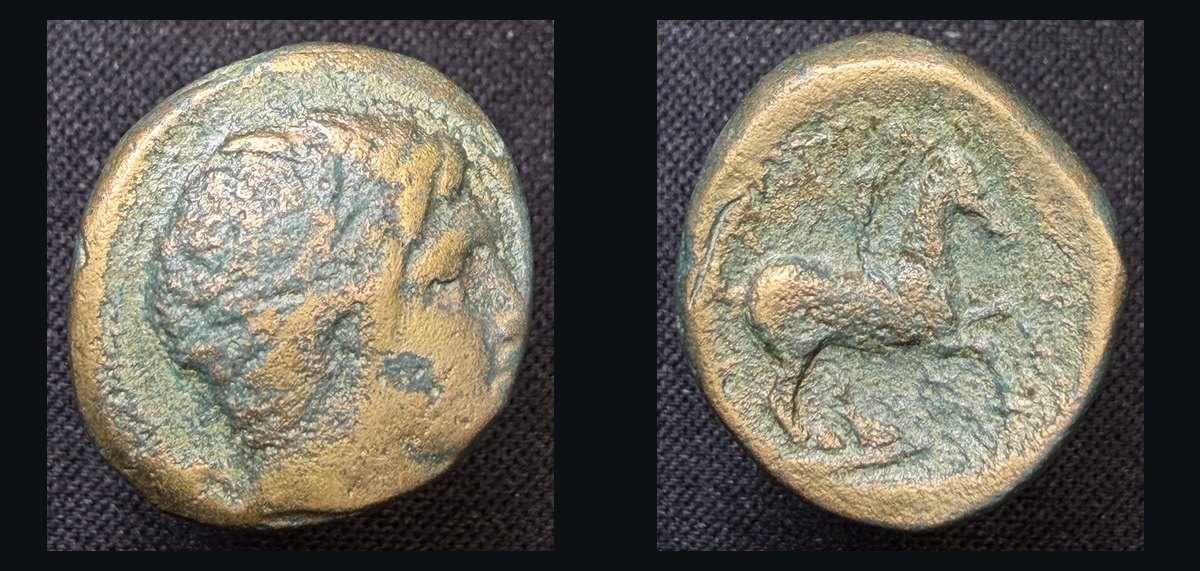
| Æ 18 (held) | Philip II, 359–336 BC & posth. | Apollo / horseman | Sear 6698 |
| AV stater | Philip II, Amphipolis, c. 340–328 BC | Apollo / biga | Le Rider 1977; ANS 1944.100.12024 |
| AV distater | Alexander III, c. 336–332 BC | Athena / Nike | Price 1991; ANS 1944.100.319 |
| AR tetradrachm | Alexander III, Tarsos, 333/2 BC | Herakles / Zeus | Price 1991; ANS 1965.77.80 |
| Æ 20 (held) | Alexander III, lifetime, 336–323 BC | Herakles / club & bow | SNG Cop. 1055 type |
| AR drachm (held) | Alexander III, prob. Sardes, c. 334–319 BC | Herakles / Zeus | Price / ADM I, pending |
| AR tetradrachm (held) | Alexander III, Kolophon, c. 325–319 BC | Herakles / Zeus | Sear 6717 var.; Price pending |
| AR tetradrachm (slot) | Alexander III, Myriandros, c. 325–323 BC | Herakles / Zeus | Price 3230 |
| AR decadrachm | Alexander III, Susa/Babylon?, c. 325–323 BC | Alexander v. Porus / Alexander with thunderbolt | Holt 2003; ANS 1959.254.86 |
| AR tetradrachm (held) | In Alexander's name, Amphipolis, c. 320–317 BC | Herakles / Zeus | Price 129 |
| AR tetradrachm | Philip III, Sardes, c. 323–319 BC | Herakles / Zeus | Price 1991 (P-series) |
| AR tetradrachm | Ptolemy I (satrap), c. 319–311 BC | Alexander in elephant scalp / Zeus | Lorber CPE; ANS 1957.172.1269 |
| AR tetradrachm | Lysimachos, Lampsakos, c. 297–281 BC | Deified Alexander / Athena | Thompson 1968; ANS 1997.9.70 |
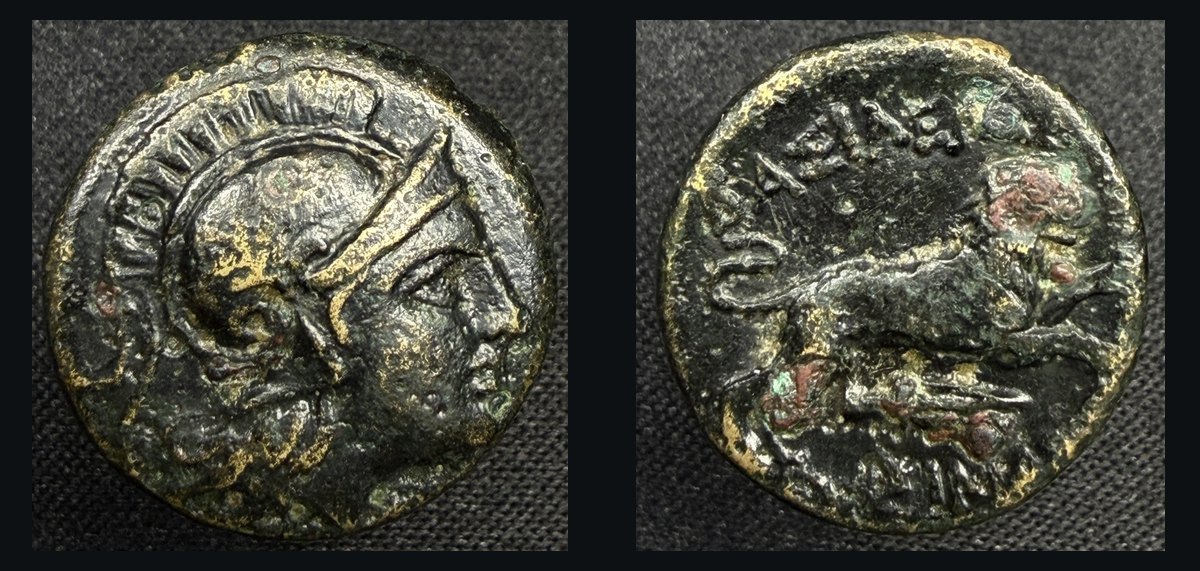
| Æ 18 (held) | Lysimachos, Lysimacheia, c. 305–281 BC | Athena / lion | SNG Cop. 1149 |
| AR tetradrachm (held) | Seleukos I, Susa, c. 305/4–295 BC | Hero in panther-skin helmet / Nike & trophy | SC 173.12; HGC 9, 20 |
| AR tetradrachm | Demetrios Poliorketes, c. 292–287 BC | Demetrios / Poseidon | Newell 1927; ANS 1967.152.208 |
| AR didrachm (held) | Rhodes, c. 305–275 BC | Helios / rose | Ashton 98; HGC 6, 1433 |
| AR tetradrachm | Ptolemy I (king), c. 294–285 BC | Ptolemy / eagle | Lorber CPE; ANS 1944.100.73309 |
| AR tetradrachm | Antiochos I, Seleukeia, 281–261 BC | Antiochos / Apollo on omphalos | SC; ANS 1946.89.93 |
| Æ hemidrachm (held) | Ptolemy III, Alexandria, c. 246–230 BC | Zeus Ammon / eagle | Lorber CPE B371; Svoronos 974 |
| AR tetradrachm (held) | Cleopatra VII, Paphos, 43/42 BC | Ptolemy I / eagle | Svoronos 1824 |
Sources
Ancient: Arrian, Anabasis of Alexander (the best surviving account, drawn from Ptolemy and Aristoboulos); Plutarch, Life of Alexander; Diodorus Siculus XVII; Quintus Curtius Rufus, History of Alexander; Justin XI–XIII; Strabo XV. For the campaigns: A. B. Bosworth, Conquest and Empire: The Reign of Alexander the Great (1988); the battle maps follow the Department of History, U.S. Military Academy, West Point. For the coinage: M. J. Price, The Coinage in the Name of Alexander the Great and Philip Arrhidaeus (1991), and the American Numismatic Society's PELLA database built on it; H. A. Troxell, Studies in the Macedonian Coinage of Alexander the Great (ANS NS 21, 1997); M. Thompson, Alexander's Drachm Mints I: Sardes and Miletus (1983); G. Le Rider, Alexander the Great: Coinage, Finances, and Policy (2007); O. Casabonne, La Cilicie à l'époque achéménide (2004); F. de Callataÿ, “A Quantitative Survey of Hellenistic Coinages” (2005) and later papers on the volume of Alexander's coinage; F. L. Holt, Alexander the Great and the Mystery of the Elephant Medallions (2003); K. Dahmen, The Legend of Alexander the Great on Greek and Roman Coins (2007); C. C. Lorber, Coins of the Ptolemaic Empire (2018); P. Thonemann, The Hellenistic World: Using Coins as Sources (2015), whose chapters on Alexander's finances and the Successors' portraits shaped the arithmetic and the argument here.
Image credits & licences (all)
Collection coins: photographed by the owner; Amphipolis, Kolophon, Sardes and Pella Alexanders; Philip II, Lysimachos, Seleukos I, Ptolemy III, Rhodes, Cleopatra VII; Croeseid and Achaemenid sigloi, Mazaios stater, Corinth stater, Athenian and Egyptian owls.
ANS coins (public domain, American Numismatic Society): 1944.100.12024 (Philip II stater); 1967.152.197 (Philip II tetradrachm); 1944.100.319 (distater); 1965.77.80 (Tarsos); 1944.100.80183 (Babylon); 1947.98.38 (Amphipolis 324–323); 1944.100.29876 (Lampsakos drachm); 1959.254.86 (Porus decadrachm); 1944.100.34250 (Price 3230, via PELLA); 1944.100.31284 (Philip III); 1957.172.1269 and 1944.100.73309 (Ptolemy I); 1997.9.70 (Lysimachos); 1946.89.93 (Antiochos I); 1967.152.208 (Demetrios).
Maps: Granicus, Issus (2), Gaugamela (2), Hydaspes (2) — Dept. of History, United States Military Academy, cartographer Frank Martini; public domain (U.S. Federal Government). Empire and campaign map — “MacedonEmpire.jpg”, Generic Mapping Tools, Wikimedia Commons, CC BY-SA 3.0.
Data figure: the mint timeline is drawn by img/gen_mint_timeline.py from M. J. Price (1991) as encoded in the American Numismatic Society's PELLA database, Open Database Licence 1.0, © American Numismatic Society.
Photographs (Wikimedia Commons): Alexander Sarcophagus — Ronald Slabke, CC BY-SA 3.0. Vergina Tomb II façade — Sarah Murray, public domain. Persepolis Apadana — Ivan Mlinaric, CC BY 2.0. Alexander Mosaic — Carole Raddato, CC BY-SA 2.0; detail of Alexander from the same mosaic — public domain. Azara Herm — Jastrow, public domain. Philip II portrait (Ny Carlsberg IN 2263) — Jastrow, CC BY 4.0.