Type · kaulonia-apollo-stag-nomos
Current: Bruttium, Kaulonia, AR nomos (stater), c. 475–425 BC (Noe, Caulonia, Group F, 84; HN Italy 2046)
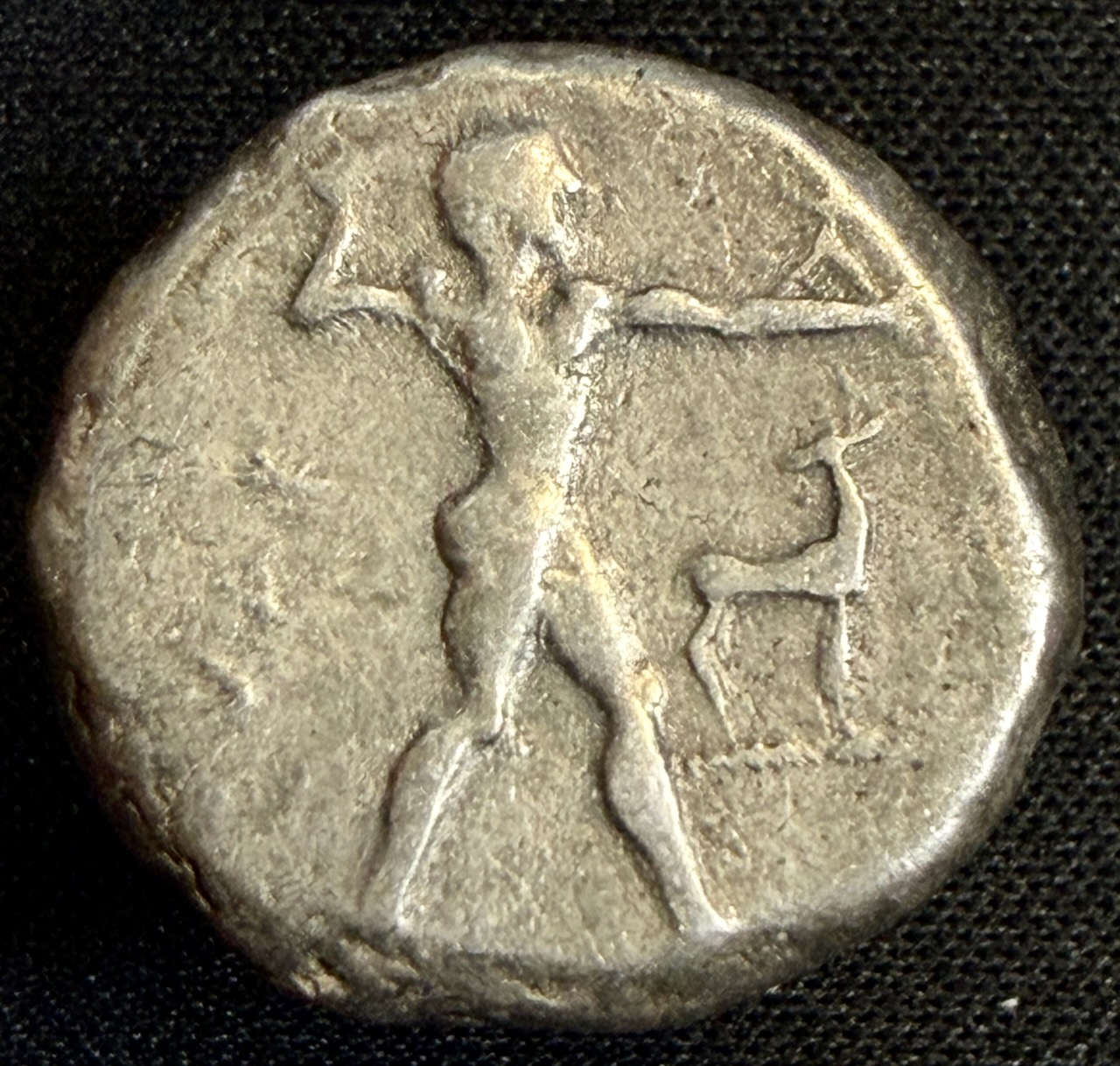
Obverse: Apollo, nude, advancing right, laurel branch in raised right hand, small daimon running right on his extended left arm; in right field, stag standing right with head reverted
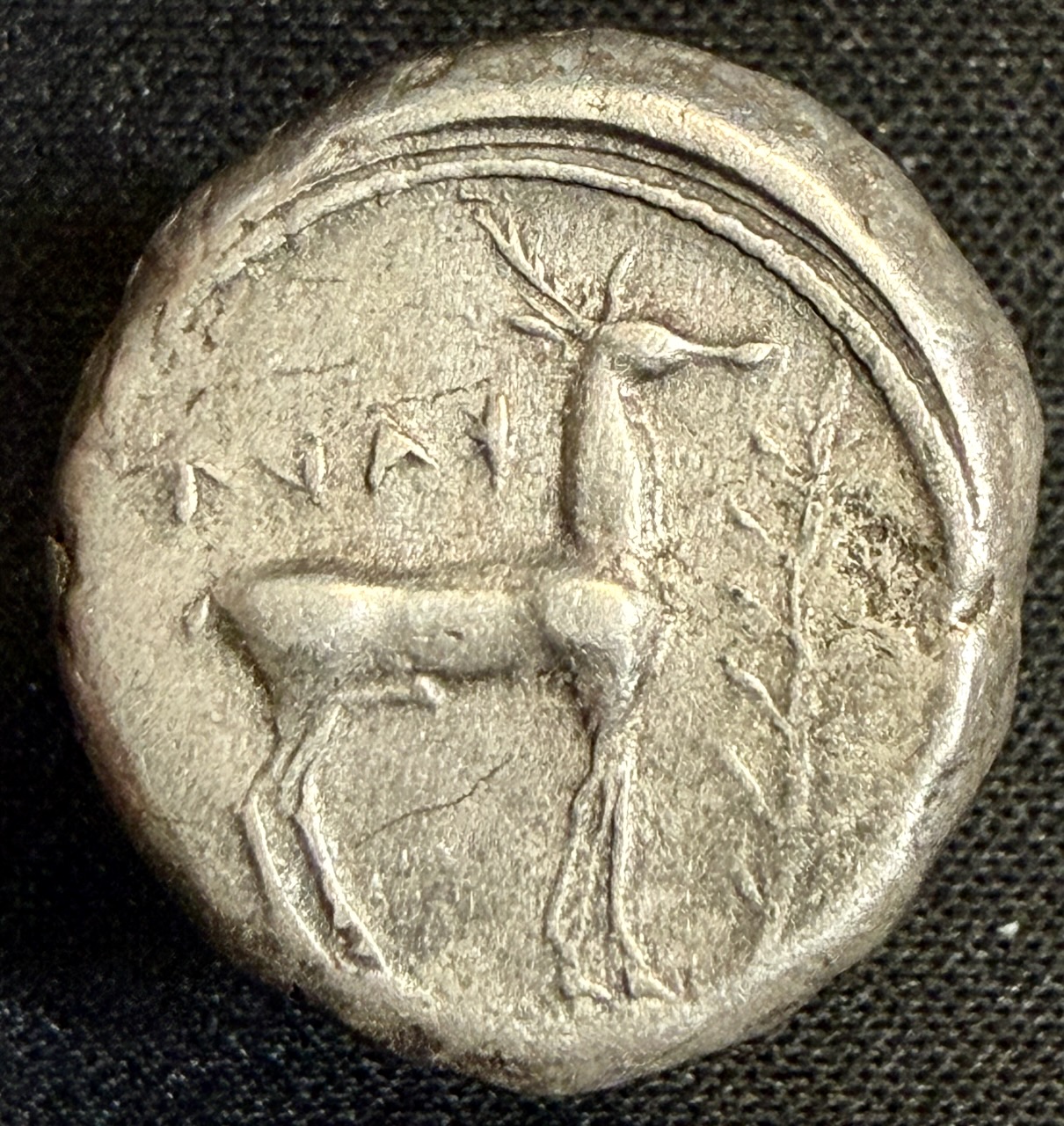
Reverse: Stag standing right; laurel branch to right
Primary reference: Noe, Caulonia, Group F, 84
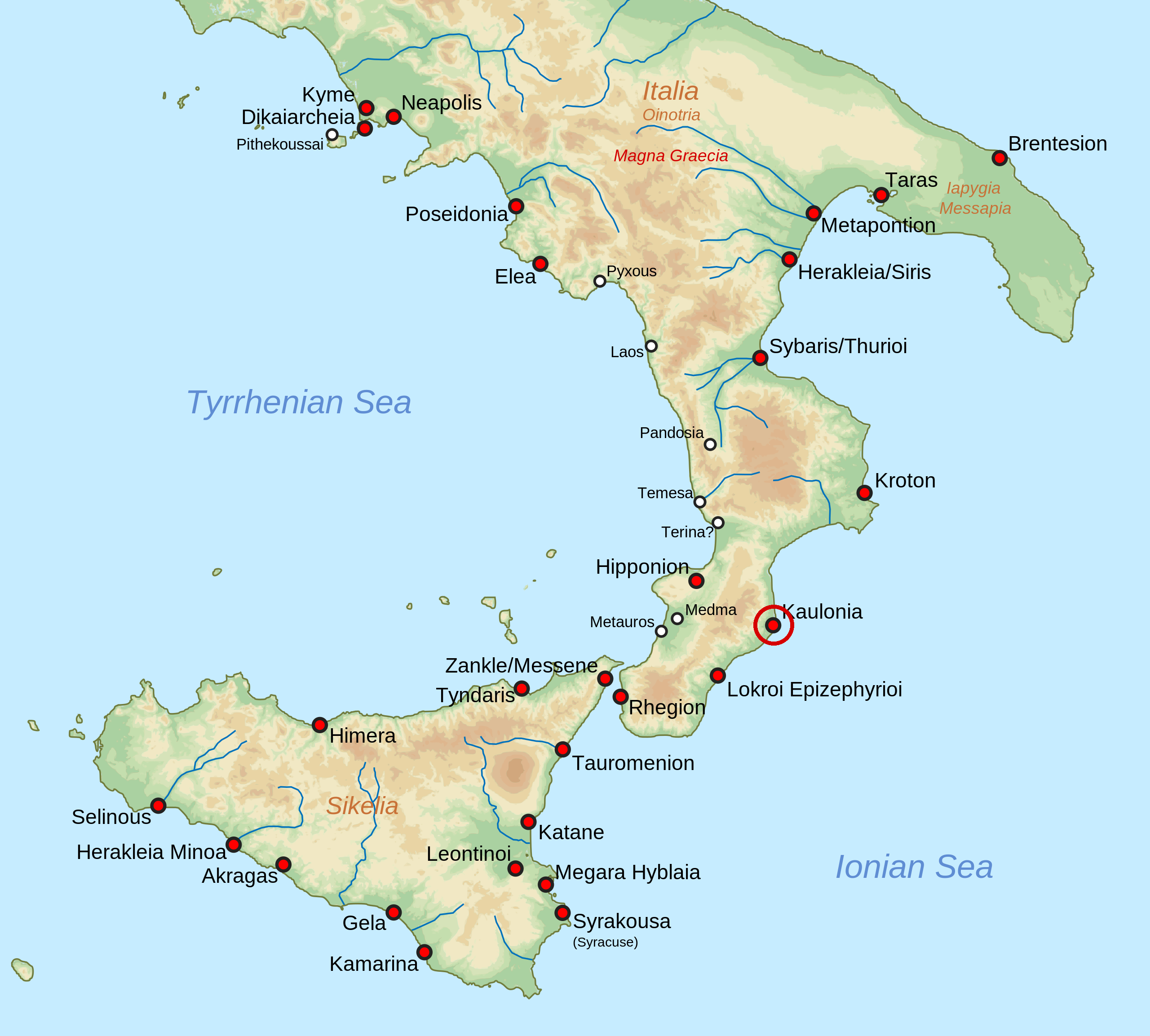
Magna Graecia and Sicily, with the Greek colonies marked. Kaulonia — circled in red — sits on the Ionian coast of Bruttium, the “toe” of Italy, between its greater Achaean neighbor Kroton up the coast to the northeast and Lokroi Epizephyrioi to the southwest. The cluster of rivals around the strait — Rhegion, Zankle/Messene — and Syracuse further down the Sicilian coast frame the world in which the city’s silver circulated, and from which its destroyer, Dionysius I of Syracuse, came in 389 BC.
“Ancient Magna Graecia map en.svg” by Tomisti (Wikimedia Commons), from the Tomisti Atlas of Ancient Geography series, based on the Digital Atlas of the Roman Empire (DARE) and Pleiades; topographic base © OpenMapTiles, © OpenStreetMap contributors. Licensed CC BY-SA 4.0 (https://commons.wikimedia.org/wiki/File:Ancient_Magna_Graecia_map_en.svg; license: https://creativecommons.org/licenses/by-sa/4.0/). Modified by JSB Coins: rasterized from SVG to PNG, and a red circle added to mark Kaulonia. This derivative is shared under the same CC BY-SA 4.0 license.
The silver of Kaulonia carries one of the strangest and most discussed images in all Greek coinage: a nude, striding Apollo brandishing a laurel branch, with a tiny running figure — the catalogues call him simply a daimon — balanced on the god’s outstretched arm, and a stag standing watchfully in the field. The city kept this design, essentially unchanged, from its first archaic incuse staters through the double-relief nomoi of the fifth century, of which this coin is a fine classical example. Whatever the scene meant, it meant it intensely and durably: few Greek cities were so faithful to a single image.
Graphic: JSB Coins (CC0).
Kaulonia stood on the Ionian coast of what is now Calabria, in the territory the ancients called Bruttium, between the greater Achaean foundations of Kroton to the south and Lokroi Epizephyrioi beyond. The tradition recorded by Pausanias (6.3.12) makes it an Achaean colony, founded by Typhon of Aigion, and its institutions and coinage alike tie it to the Achaean bloc of Magna Graecia. That affiliation is visible in the money itself: Kaulonia struck on the South Italian “Achaean” weight standard (nomos of c. 8.0 g; Rutter, HN Italy) and began, like Kroton, Sybaris, and Metapontion, with the region’s extraordinary incuse technique — obverse type in relief, the same type repeated incuse on the reverse. The incuse fabric is one of the technical wonders of early coinage: the reverse die was cut as a hollow mirror of the obverse, so the same figure appears raised on one face and sunken on the other, in perfect register, on flans hammered broad and paper-thin. Why the Achaean cities chose so laborious a method is unresolved — explanations have ranged from guarding against fraud to the influence of the region’s metalworking traditions (the once-popular idea that Pythagoras, resident at Kroton, designed the fabric is a romantic guess with no ancient support). Around 475 BC the incuse fabric was abandoned across the region, and Kaulonia’s stater became a conventional two-sided coin: Apollo and his daimon on the obverse, the stag alone, with a laurel sapling, on the reverse. This coin belongs to that first double-relief century, the period of the city’s prosperity before Dionysius I of Syracuse destroyed it in 389 BC and removed its people (Diodorus 14.106).
What is happening on the obverse has never been settled. Apollo is identifiable enough — the laurel branch and the stag are both his (the stag equally his sister Artemis’s) — but the little running figure on his arm has resisted explanation since the nineteenth century. The standard references decline to interpret: Noe’s die corpus (1958) and Rutter’s Historia Numorum: Italy simply describe a “daimon,” and the dealer’s tag for this specimen follows them. Proposals in the older literature have ranged from a spirit of purification connected with Apollo Katharsios to a wind daimon, but none has won consensus, and this page follows the catalogues in leaving the question open. It is one of a handful of major Greek coin types whose central image remains, in the plainest sense, unexplained — which is itself part of the type’s fascination: the scene was evidently transparent to the Kauloniates and is opaque to us.
The nomos (the South Italian term for the stater) was the workhorse denomination of the Achaean cities’ shared monetary zone, and the common standard let the coinages of Kroton, Metapontion, Sybaris, and Kaulonia circulate side by side in regional trade. Kaulonia was the smallest of the Achaean minting cities, and its output was correspondingly modest — Noe’s corpus organizes the double-relief issues into lettered die groups (this coin’s dies are his Group F, no. 84), a series that ends with the city’s destruction in 389 BC. After Dionysius, Kaulonia never again struck silver on this scale, which makes the fifth-century nomoi the city’s principal numismatic legacy.
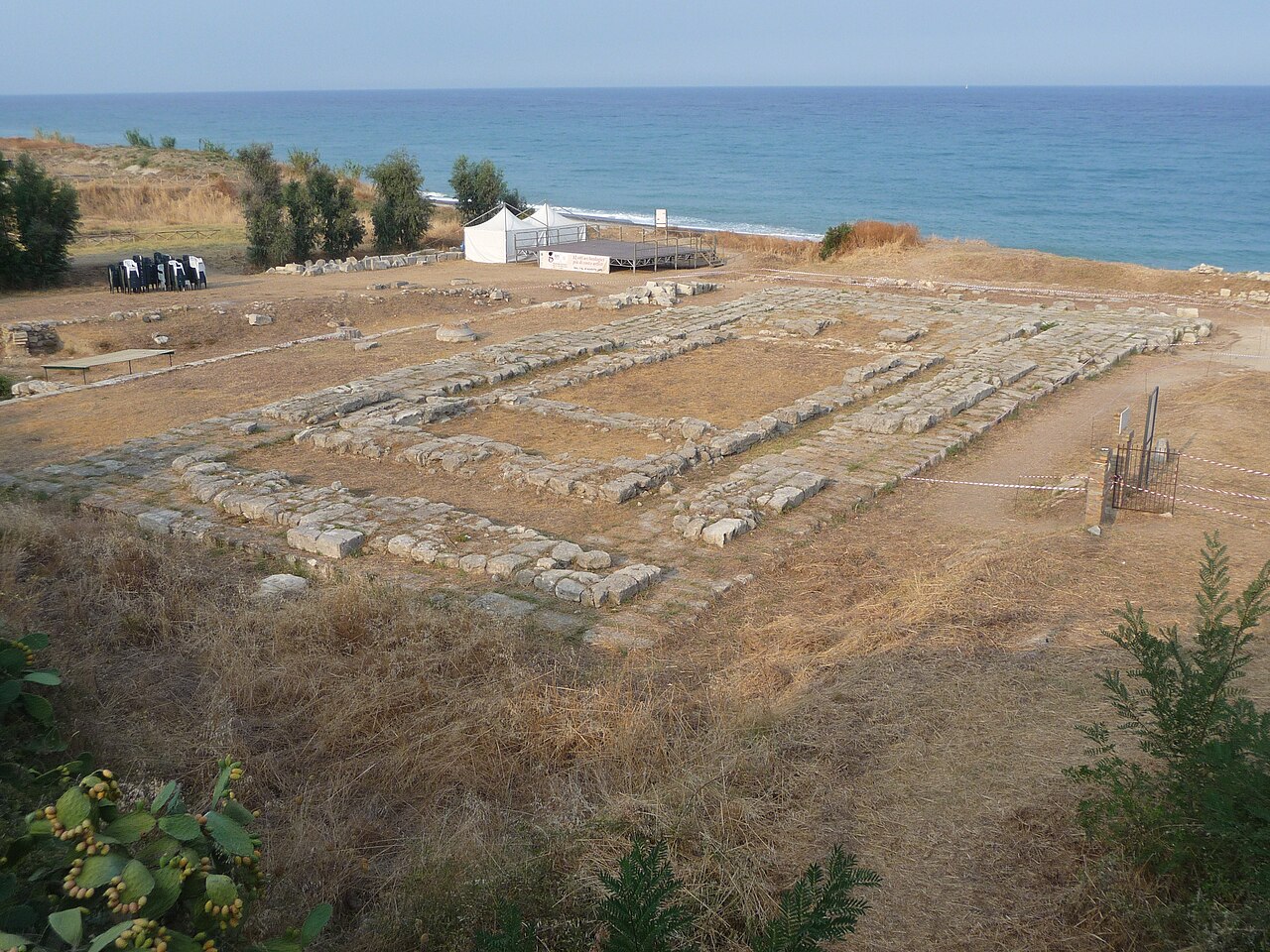
Photo: Marcuscalabresus, Wikimedia Commons, licensed CC BY 3.0, reproduced unmodified.
The city Dionysius emptied in 389 BC was modestly refounded later in the fourth century and lived on quietly into the Hellenistic age, but it never again mattered — which is precisely why its ruins, unburied by later greatness, preserve a fifth-century Achaean colony’s footprint so legibly.
Attribution and dies: S. P. Noe, The Coinage of Caulonia (ANS Numismatic Studies 9, 1958), Group F, no. 84 (same dies, per the dealer’s tag); N. K. Rutter (ed.), Historia Numorum: Italy (2001), no. 2046; SNG Copenhagen 1710 (same dies); dealer’s description (Classical Numismatic Group, inv. 161982). Weight standard and the incuse-to-double-relief transition: Rutter, HN Italy (Achaean standard; Kaulonia section). Foundation: Pausanias 6.3.12. Destruction by Dionysius I: Diodorus Siculus 14.106 (linked in the references). On the incuse technique and its unresolved purpose: Rutter, HN Italy, introduction, with Kraay, Archaic and Classical Greek Coins. The daimon’s interpretation is left open following Noe and HN Italy, which describe without explaining the figure.
Struck on the South Italian 'Achaean' standard shared by the Achaean colonies (nomos/stater of c. 8.0 g; Rutter, HN Italy). Double-relief issue succeeding Kaulonia's archaic incuse coinage of the same types. The dealer's tag notes this specimen is from the same dies as Noe 84 and SNG Copenhagen 1710. The meaning of the small running figure ('daimon') on Apollo's arm is an unresolved question of Greek numismatic iconography — see essay.
John's Ancient Coin Collection · Type · kaulonia-apollo-stag-nomos
Where the mints are — every mint in the collection on a modern map
Image credits for this coin — photographs, maps and graphics used on this page